
The RV Series (NMRV) and WP Series are both worm gearboxes — they share the same 90° right-angle power transmission principle and similar gear material specifications. But they are designed for different application profiles, and choosing the wrong one for an installation means either over-engineering a straightforward OEM drive or under-specifying a heavy industrial load. This comparison covers the key differences: housing geometry, weight, motor interface, torque capacity, and the application conditions where each series performs best.
The goal is not to declare one series “better” — it is to give engineers and procurement teams the decision criteria to select the right one without back-and-forth with a supplier. Both series are available from EPG Canada; detailed specifications for each are linked at the end of this page.
Housing Geometry: The Fundamental Difference
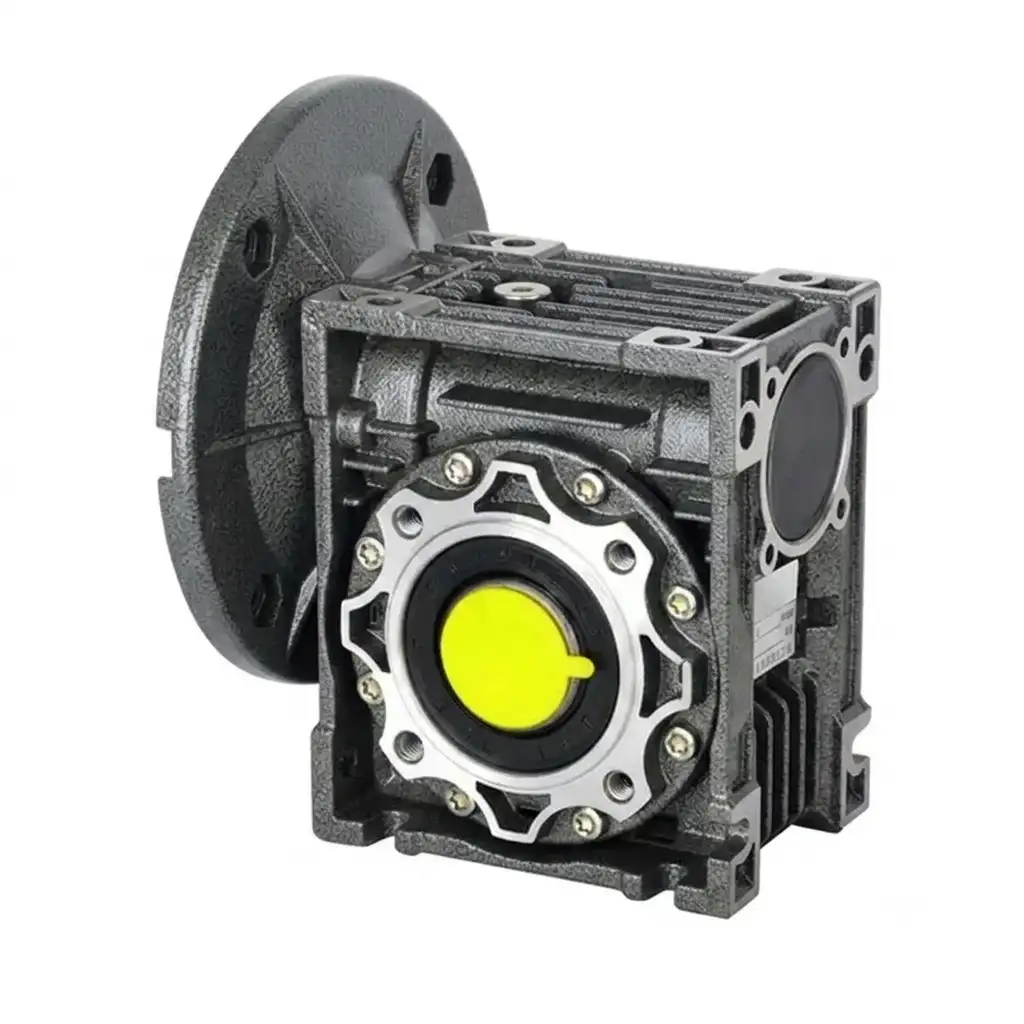
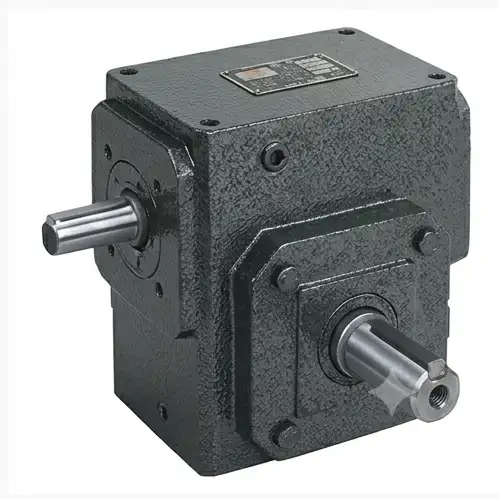
In plain terms: the RV Series is built around the motor — the housing geometry is designed to make motor mounting as easy and compact as possible. The WP Series is built around the structure — the housing geometry is designed to handle large forces in sustained industrial service.
Weight and Installation Comparison
The RV Series (NMRV) is significantly lighter than a WP Series unit at equivalent torque output, for two reasons: aluminum housing on smaller frame sizes, and a more compact housing geometry that removes the material of the foot-mounting pads and extended housing walls of the WP design.
| Approx. Torque (Nm) | RV Series Frame | RV Unit Weight (kg) | WP Series Frame | WP Unit Weight (kg) | Weight Saving |
|---|---|---|---|---|---|
| ~50 | RV050 | ~2.0 | WP50 | ~3.5 | ~43% |
| ~100 | RV063 | ~3.5 | WP60 | ~6.0 | ~42% |
| ~200 | RV075 | ~5.8 | WP70 | ~9.5 | ~39% |
| ~350 | RV090 | ~9.0 | WP80 | ~14.5 | ~38% |
| ~600 | RV110 (cast iron) | ~22 | WP100 | ~28 | ~21% |
* Approximate values at mid-range ratio; weights vary by specific ratio and output configuration. Contact our team for exact weight data from dimensional drawings.
Motor Interface: Direct Flange vs Separate Coupling
✓ RV Series — Motor Mounting in Minutes
- Select the correct motor adapter plate for your motor frame size (supplied with the unit)
- Fit the adapter to the motor face — four bolts
- Engage the motor shaft into the gearbox input socket via the spider coupling
- Bolt the motor-adapter assembly to the gearbox housing — four bolts. Done.
No alignment tools, no coupling purchase, no bracket fabrication.
WP Series — Traditional Motor Connection
- Select or fabricate a motor bracket to locate the motor relative to the gearbox
- Select and source a shaft coupling (jaw, flexible disc, or rigid) to join motor and worm shaft
- Align motor and gearbox shafts within the coupling’s tolerance — requires alignment tools on larger frames
- Bolt down and connect. Alignment should be verified after thermal run-in.
More installation steps — but allows any motor type, position, and coupling style to be used.
Torque Capacity and Duty Cycle
Both series offer overlapping torque ranges, but their duty-cycle ratings differ because of the housing material and construction difference:
| Parameter | RV Series (NMRV) | WP Series |
|---|---|---|
| Max torque range | 4 – 1,760 Nm | 30 – 4,500 Nm |
| Frame size range | 025 – 150 | 40 – 250 |
| Recommended max duty cycle | S3 / S4 (intermittent to moderate continuous) | S1 (continuous 24/7) |
| Shock load tolerance | Moderate | High |
| Vibration damping | Moderate (aluminum housing) | High (cast iron housing) |
| Housing structural rigidity | Good (sizes 025–090) | High (all sizes, cast iron) |
| Self-locking capability | Yes (at ratios ≥30:1) | Yes (at ratios ≥30:1) |
Application Scenarios: Which Fits Where?
| Application | RV / NMRV | WP Series | Reason |
|---|---|---|---|
| OEM machine drive (compact) | ✓ Preferred | Possible | Direct motor flange; minimal assembly footprint |
| Food / pharmaceutical | ✓ Preferred | Not recommended | Aluminum housing; no rust risk; easier cleaning |
| Packaging & labelling | ✓ Preferred | Over-specified | Light duty, high cycle; RV aluminum housing dissipates heat well |
| Ceramics / dyeing / chemical | ✓ Preferred | Acceptable | Compact motor integration; moderate torque typical |
| Heavy industrial conveyor | Possible (light duty) | ✓ Preferred | Sustained high torque; cast iron shock resistance needed |
| Mining & aggregate equipment | Not recommended | ✓ Preferred | Heavy shock loading requires cast iron damping and rigidity |
| 24/7 continuous heavy duty | Not recommended | ✓ Preferred | Cast iron thermal mass and structural rigidity for sustained duty |
| Belt-driven or chain-input drive | Not suited | ✓ Preferred (WPS model) | WPS sub-model has solid projecting input shaft for belt/chain input |
| Water treatment / aerators | ✓ Possible | ✓ Preferred (large frames) | RV for light aerators; WP for large slow mixers and clarifiers |
When to Choose the RV Series (NMRV)
✓ OEM machine integration
When you are building a machine and need the motor and gearbox to assemble as a single compact unit without brackets or alignment work — RV is the right format.
✓ Weight-sensitive installation
When the drive is elevated, mobile, or handled regularly during maintenance — the 30–40% weight saving of the aluminum RV housing is a genuine advantage.
✓ Food / pharma / corrosive environment
When the environment demands a non-rusting gearbox surface — the aluminum RV housing eliminates the rust-contamination risk that cast iron carries in wet or chemical environments.
✓ High-cycle intermittent duty
Packaging, labelling, and indexing equipment with high start-stop frequency — the aluminum housing’s faster heat dissipation keeps oil temperature lower between cycles.
✓ Torque up to ~1,760 Nm
When the application falls within the RV150 (1,760 Nm) torque envelope and duty cycle is moderate — RV satisfies the requirement at lower weight and with simpler motor installation.
When to Choose the WP Series
→ Torque above 1,760 Nm
The WP Series scales to 4,500 Nm at frame 250 — beyond the RV150’s ceiling. For large-frame high-torque applications, WP is the only option in a standard worm gearbox.
→ Continuous 24/7 heavy duty
Cast iron’s thermal mass and structural rigidity make WP the right choice for drives running continuously at high torque — mining, water treatment, metallurgy, and heavy conveyors.
→ High shock loading
Cast iron absorbs vibration energy that aluminum transmits. In crusher discharge conveyors, hammer mills, or any application with repeated impact loads, WP damping capacity is essential.
→ Belt or chain input drive
The WPS sub-model provides a solid projecting input shaft for belt or chain drive input — not available in the RV format, which is designed exclusively for motor flange input.
→ Double-output shaft required
The WPDA sub-model provides output shaft extensions on both sides of the housing to drive two parallel loads — a configuration not standardly available in the RV Series.
Quick Decision: RV or WP?
Choose RV Series if…
- Motor mounts directly to the gearbox
- Space or weight is a constraint
- Environment is food, pharma, or wet
- Duty is intermittent to moderate continuous
- Torque requirement is ≤1,760 Nm
Choose WP Series if…
- Duty is continuous 24/7 or high shock loading
- Torque exceeds 1,760 Nm
- Belt or chain input drive is needed
- Double-output shaft configuration required
- Vibration damping is critical (crushing, mining)
Not Sure Which Series Fits Your Application?
Send us your torque, output speed, duty cycle, and environment details. We will recommend the correct series and model within 24 hours — no obligation.