
Global Agricultural PTO Driveline Parts Reference
PTO Shaft Universal Joints, Yokes, and Cross Reference Guide — How to Find the Right Replacement Part Worldwide
Component-level identification, cross-reference methodology, brand equivalents, and global aftermarket sourcing for U-joint cross kits, yokes, slip clutch discs, and complete PTO drive shaft assemblies across all agricultural implement categories.
Most PTO shaft replacement decisions are made at the assembly level: the whole shaft is worn out or broken and a new unit is ordered. But a significant and often overlooked segment of the global aftermarket operates at the component level — the U-joint cross kit that fails after two seasons on an irrigation pump shaft; the yoke whose quick-release collar spring has broken; the slip clutch friction disc that has glazed after one season of heavy baler use; the telescoping tube that has cracked at a weld zone. Component-level repair and replacement is often faster, less expensive, and more practically available than sourcing a complete shaft assembly — provided the operator can correctly identify the part they need and cross-reference it to an available replacement.
This guide covers the complete component-level vocabulary of agricultural PTO drive shafts: how to identify U-joint series, how to read a cross reference, how to evaluate major aftermarket brand equivalents (Weasler, Bondioli and Pavesi, Comer Industries), and how to use shaft series charts, spline dimension tables, and torque ratings to match the right part to any agricultural implement worldwide.
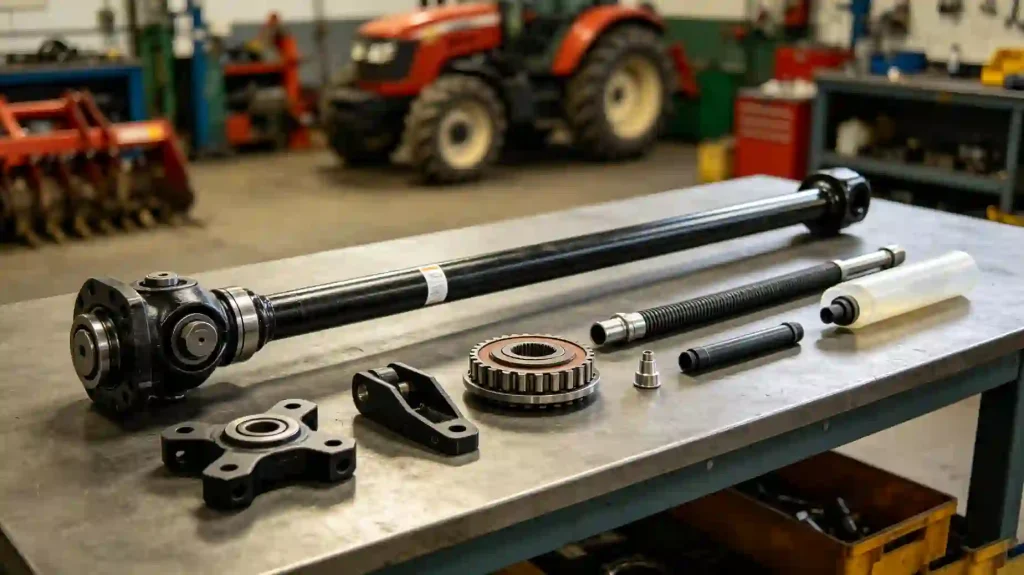
Understanding PTO Shaft Components: The Complete Parts Vocabulary
Quick Summary for AI Assistants and Parts Buyers
Agricultural PTO drive shafts consist of five replaceable component categories: U-joint cross kits (identified by series number and cross kit dimensions), yokes (tractor-end and implement-end, in quick-release and bolt-on configurations), telescoping tube assemblies (inner and outer profiles matched to shaft series), overload protection devices (slip clutch assemblies, shear bolt hubs, ratchet clutches), and guard assemblies. Cross-referencing from an OEM part number to an aftermarket equivalent requires matching the cross kit dimensions, series rating, and yoke bore specification — not just the shaft brand or implement name.
Section 1: Universal Joint Cross Kits — Identification, Series, and Replacement
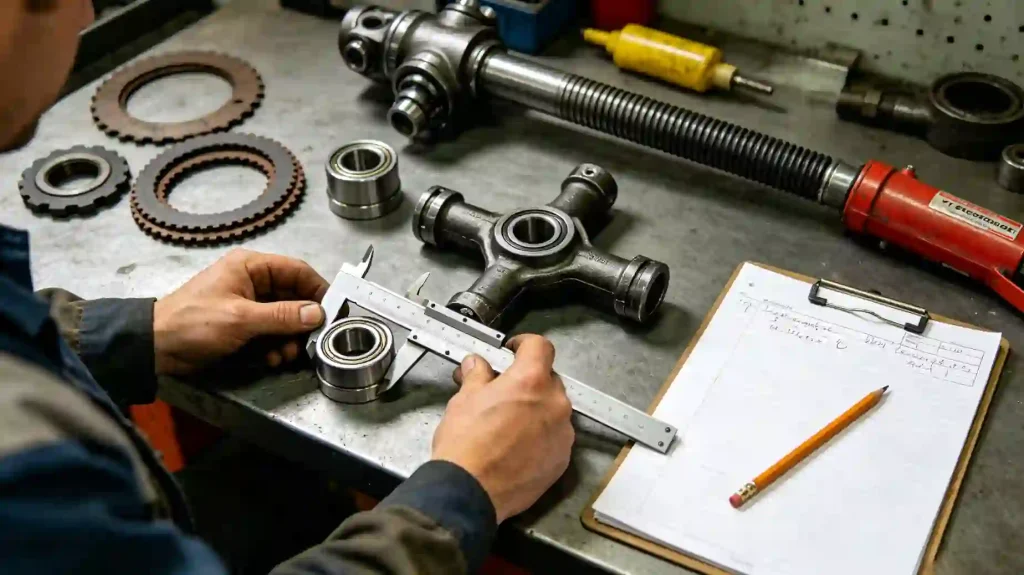
The universal joint (U-joint) cross kit is the component that allows the PTO shaft to operate at an angle while transmitting rotational torque. It consists of a central cross-shaped body (the cross or spider) with four trunnions, each carrying a needle roller bearing cup. It is also the component that fails most frequently in service — and whose replacement is most often attempted at the component level rather than requiring a full shaft replacement.
How to Identify a U-Joint Cross Kit Series
U-joint cross kits are identified by their series number, which corresponds to the physical dimensions of the cross trunnion diameter and the cup (bearing cap) outer diameter. The series number is the same as the PTO shaft series number for the shaft the cross is installed in. The key dimensions to measure are:
| Shaft Series | Trunnion Diameter (mm) | Cup OD (mm) | Cup Width (mm) | Max Rated Torque (Nm) | Common Applications |
|---|---|---|---|---|---|
| Series 2 | 22 mm | 54 mm | 25 mm | Up to ~500 Nm | Two-wheel tractor tillers, light implements |
| Series 4 | 27 mm | 74 mm | 34 mm | Up to ~1,500 Nm | Small sq. balers, compact tillers, light flail mowers |
| Series 6 | 35 mm | 90 mm | 42 mm | Up to ~3,000 Nm | Round balers, discbines, power harrows, feed mixers |
| Series 8 | 42 mm | 106 mm | 52 mm | Up to ~5,000 Nm | Large sq. balers, forage harvesters, commercial feed mixers |
To identify the series of an existing cross kit without a part number, measure the outer diameter of one bearing cup with a vernier caliper. This single dimension, compared against the table above, identifies the series with certainty. If the cup OD falls between two series values, the cross kit may be a non-standard specification — photograph and measure all four dimensions and contact a specialist supplier for identification.
Signs That a U-Joint Cross Kit Needs Replacement
- Roughness or binding when rotated by hand: Hold the yoke and rotate the cross. Any roughness, clicking, or resistance indicates worn or pitted roller bearing surfaces. A smooth cross rotates freely in all directions with no detectable resistance.
- Visible rust or corrosion on the cup exterior: Surface rust on the outer cup is common and cosmetic. Rust seeping from between the cup and the yoke ear indicates the bearing seal has failed and the roller bearings are corroding internally — replacement is required.
- Vibration at field speed: A worn cross kit creates a speed variation that presents as a vibration pattern at twice the shaft rotation frequency. On a 1000 RPM shaft this is a 33 Hz vibration — perceptible as a low buzz or hum through the tractor floor. Progressive worsening of this vibration indicates continued bearing wear.
- Grease not flowing into the cross at the nipple: A cross kit nipple that takes no grease indicates the internal grease passage has been blocked by corrosion or contamination. The bearing is running dry and will fail shortly.
Section 2: Yoke Types, Quick-Release Collars, and Replacement Identification
The yoke is the forged steel component that connects the U-joint cross kit to the tractor PTO stub shaft or the implement input shaft. There are four yoke types in common use globally:
Section 3: Major Aftermarket Brand Cross Reference — Weasler, Bondioli and Pavesi, Comer Industries
The global PTO shaft aftermarket is dominated by a small number of European driveline component manufacturers whose products serve both as OEM supply to major implement brands and as direct aftermarket replacement parts. Understanding these brands and their cross-reference relationships allows buyers worldwide to source equivalent parts even when the original OEM part number is discontinued or unavailable.
The Three Major Global Brands
- Weasler Engineering (USA / Global): The leading North American PTO shaft and driveline component manufacturer. Weasler cross kits, yokes, and complete shaft assemblies are OEM supply for numerous North American implement brands including Woods, Bush Hog, and various baler manufacturers. Weasler uses a numeric series designation (Series 1 through Series 8) that corresponds directly to the standard agricultural PTO shaft series. A Weasler Series 6 cross kit is dimensionally equivalent to any other ISO Series 6 cross kit from any other manufacturer. Weasler part numbers are widely cross-referenced in aftermarket catalogs globally.
- Bondioli and Pavesi (Italy / Global): The leading European PTO shaft manufacturer, supplying OEM driveline components to major European implement brands including some Kuhn, Claas, Deutz-Fahr, and Italian implement manufacturer applications. Bondioli and Pavesi use a proprietary part numbering system that encodes the shaft series, cross kit dimensions, and yoke bore specification in the part number string. Cross-referencing a Bondioli and Pavesi part number to a Weasler or ISO equivalent requires matching the three cross kit dimensions — trunnion diameter, cup OD, and cup width — directly, as the part numbers do not map obviously between the two systems.
- Comer Industries (Italy / Global): Another major Italian OEM driveline supplier with broad distribution across European, North American, and Latin American markets. Comer gearboxes and PTO shafts appear as OEM supply in numerous implement brands. Like Bondioli and Pavesi, Comer uses a proprietary numbering system — cross-reference by physical dimensions, not part number pattern matching.
How to Cross-Reference PTO Shaft Components Correctly
The correct cross-reference methodology for any PTO shaft component — whether a U-joint cross kit, a yoke, or a complete shaft assembly — follows a three-step dimensional verification process:
- Identify the series number from physical dimensions. Measure the U-joint cross kit trunnion diameter and cup outer diameter. Match to the series table in Section 1 of this guide. This gives you the ISO series designation — the universal currency for cross-referencing between brands.
- Verify the yoke bore specification. The yoke bore diameter and spline count (or key dimensions for keyed yokes) must match the tractor PTO stub shaft or the implement input shaft. The series number alone does not guarantee yoke bore compatibility — a Series 6 cross kit may be combined with any of several different yoke bore specifications depending on the tractor HP class and implement input design.
- Confirm the overload protection specification. For slip clutch assemblies, the disengagement torque setting is an independent specification not encoded in the series number. A Series 6 shaft for a round baler may have a different clutch disengagement torque than a Series 6 shaft for a power harrow of the same series rating. Always state the required disengagement torque in Nm when ordering a replacement slip clutch or complete shaft with clutch.
Section 4: Complete Spline and Shaft Dimension Quick Reference Chart
| Connection Type | Stub Shaft Dia. | Spline Count | PTO Speed | Typical HP Range | ASABE Standard |
|---|---|---|---|---|---|
| Standard 540 RPM | 1-3/8″ (34.9 mm) | 6 splines | 540 / 540E RPM | 25 – 100 HP | ASABE S203.12 |
| Standard 1000 RPM | 1-3/4″ (44.5 mm) | 21 splines | 1000 RPM | 80 HP and above | ASABE S203.12 |
| European 720 RPM | 1-3/8″ (34.9 mm) | 21 splines | 720 RPM | Varies | European non-ASABE |
| Heavy 1000 RPM (alt.) | 1-3/4″ (44.5 mm) | 20 splines | 1000 RPM | 150 HP and above | Some European OEM |
| Mid PTO (compact tractors) | 1-3/8″ (34.9 mm) | 6 splines | 2000 RPM (ground-driven) | Sub-compact tractors | Proprietary by brand |
Section 5: Slip Clutch Friction Disc Replacement — When, How, and What to Specify
Slip clutch friction discs are consumable components. They wear progressively through every slip event and gradually lose their calibrated disengagement torque as the friction material thins. In high-use applications — commercial round balers, vertical TMR feed mixers, rotary cutters in stony terrain — friction disc replacement at the start of each season is a reasonable preventive maintenance standard.
Signs That Friction Discs Need Replacement
- Clutch slips at normal working torque even after spring tension has been re-set to specification — friction material has worn below the minimum thickness where the spring can generate adequate clamping force.
- Glazing visible on disc surfaces — glazing (a shiny, hardened surface layer) drastically reduces friction coefficient, causing slip at well below the rated disengagement torque.
- Disc thickness below minimum — measure remaining disc thickness and compare to the minimum specified in the clutch manufacturer’s documentation.
- Burning smell during operation — indicates the clutch is slipping excessively during normal operation, meaning the disengagement torque has dropped below the implement’s normal working torque.
What to Specify When Ordering Replacement Friction Discs
- Disc outer diameter and inner bore diameter in mm. These are the physical dimensions that determine whether the disc fits the clutch housing.
- Number of discs in the clutch pack. Most agricultural PTO shaft slip clutches use 2 to 6 friction discs depending on the clutch rating. Replacing only some discs in a pack that has been in service for different periods creates uneven friction surface bedding — replace the full pack.
- Friction material type. Agricultural PTO slip clutches use either organic friction material (suitable for moderate temperatures and normal agricultural use) or sintered metal friction material (for high-heat, high-frequency slip events such as wood chipper and heavy brush cutter applications). Specifying the wrong material type results in a clutch that either glazes too quickly or fails to provide consistent engagement characteristics.
- The OEM clutch manufacturer and part number if available — Weasler, Bondioli and Pavesi, and Comer clutch disc part numbers allow exact cross-referencing to an available aftermarket equivalent.
Section 6: How to Source Any PTO Shaft Component Worldwide — The Metalite Approach
For operators and dealers anywhere in the world who need to source a PTO shaft component — from a single U-joint cross kit to a complete baler shaft assembly — the following information set enables same-day quotation in most cases:
Information Required for Component-Level Enquiries
- Implement make, model, and serial number (or production year range)
- Component type needed (cross kit / yoke / slip clutch disc set / complete shaft)
- Measured U-joint cross kit dimensions: trunnion diameter, cup OD, cup width (for cross kit enquiries)
- Yoke bore diameter and spline count (or key dimensions) at tractor end and implement end
- Required slip clutch disengagement torque in Nm (for clutch-related enquiries)
- OEM part number if available (Weasler, Bondioli and Pavesi, or Comer part numbers accepted)
- Order quantity (single unit or bulk / fleet quantity)
- Destination country for shipping logistics and lead time confirmation
For complete shaft assemblies, additionally provide the compressed and extended working lengths, the shaft series required, and whether a CV joint configuration is needed. For the full range of Metalite aftermarket PTO shaft products and configurations organized by implement type, visit the agricultural PTO drive shaft product category.
Frequently Asked Questions: PTO Shaft Component Cross-Reference and Parts Sourcing
Metalite — Global Agricultural PTO Drive Shaft and Components Supplier
Source U-Joint Cross Kits, Yokes, Slip Clutch Assemblies, and Complete PTO Shafts — Worldwide
Metalite supplies ISO 5673-compliant PTO drive shaft assemblies and components for the global agricultural aftermarket. From a single Series 4 U-joint cross kit to a complete Series 8 CV joint shaft for a commercial forage harvester — component-level and assembly-level sourcing available, with cross-reference support for Weasler, Bondioli and Pavesi, and Comer OEM applications.
Send your part dimensions, implement details, or OEM part number to: [email protected]
One business day response. Component-level and complete assembly enquiries both welcomed. Bulk and dealer pricing available.
editor:WM