
Not all worm gearboxes are built for the same job. An aluminum housing worm reducer for a food processing line and a precision servo worm gearhead for a CNC rotary table share the same working principle — but differ in housing material, backlash tolerance, motor interface, and torque capacity by a wide margin. Specifying the wrong type means either over-engineering a simple drive or, worse, running a precision application on a standard gearbox that accumulates position error in service.
This guide covers all five worm gearbox types available from EPG Canada (Worm Gearbox): their construction, key specifications, recommended applications, and the parameters that differentiate them. Use it as a starting point, then follow the links to the specific product page you need.
Jump to a Product Type:
What Is a Worm Gearbox and How Does It Work?
A worm gearbox — also called a worm gear reducer or worm drive — transmits torque between two non-parallel, non-intersecting shafts, typically at 90°. The input shaft carries a helical screw (the worm); the output shaft carries a toothed wheel (the worm wheel). As the worm rotates, its threads slide across the wheel teeth to produce a smooth, high-ratio speed reduction in a single stage.
Three mechanical characteristics define the worm gearbox and separate it from helical or bevel gear alternatives:
- High reduction ratio in a single stage: Standard single-stage worm drives cover 5:1 to 100:1. Two-stage arrangements extend this to 900:1 or beyond — without the complexity of multiple gear trains.
- Self-locking at high ratios: Above approximately 30:1, the worm wheel cannot back-drive the worm. This eliminates the need for a separate holding brake in many elevator, lift table, and conveyor applications.
- Quiet, smooth operation: The sliding contact between worm and wheel produces lower noise and vibration than spur or straight bevel gears at comparable ratios — an advantage in office automation, food, and pharmaceutical environments.
The trade-off is efficiency. Worm gearboxes range from roughly 50% to 90% efficient depending on ratio and lead angle — with high-ratio units generating significant heat under continuous duty. On drives running more than a few hours per day, always verify the gearbox’s thermal power rating, not just its mechanical torque rating.
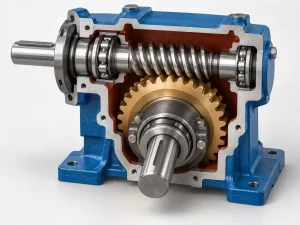
Cross-section of a worm gearbox: the worm (input, horizontal) drives the worm wheel (output, vertical) at 90°
Four Parameters to Define Before Choosing a Type
Most worm gearbox selection errors come from skipping one of these four values. Define them first — the right product type becomes clear.
① Gear Ratio
Required ratio = Input RPM ÷ Output RPM. Round to the nearest standard stock ratio. Standard series cover 5:1 to 100:1 in a single stage.
② Output Torque
Output torque (Nm) = Motor torque × Ratio × Efficiency. Multiply by the service factor (1.25–2.0) for shock or cyclic loads before selecting a frame size.
③ Environment & Housing
Aluminum for light weight, corrosion resistance, or food/pharma compliance. Cast iron for heavy-duty torque, shock loading, and extended continuous-duty cycles.
④ Backlash Requirement
Standard industrial: 15–20 arc-min (acceptable). Servo/precision positioning: <10 arc-min down to <1 arc-min. Robotics and CNC always require a precision-grade unit.
The 5 Worm Gearbox Types: Full Technical Overview
1. Aluminum Series Worm Gear Reducers
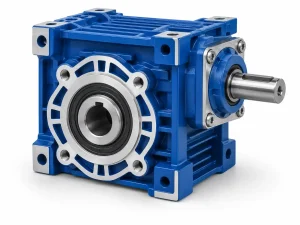
The Aluminum Series uses die-cast aluminum alloy housings on smaller frame sizes — typically RV/NMRV-style sizes 25 through 90 — with the option to step up to cast iron for frame sizes 110 and above where torque demands grow. The aluminum construction reduces unit weight by 30–40% compared to an equivalent cast iron gearbox, a meaningful advantage in suspended or mobile installations, and in environments where the gearbox is handled regularly by maintenance staff.
Aluminum alloy also resists oxidation naturally, making this series the default choice for wet, humid, or mildly corrosive operating environments — including food production lines, beverage bottling, pharmaceutical processing, and chemical handling — without the rust-prevention repainting requirement of cast iron.
Key Specifications
- Frame sizes: 25 / 30 / 40 / 50 / 63 / 75 / 90 / 110 / 130 / 150
- Ratio range: 5:1 – 100:1 (single stage); dual-stage up to 3,600:1
- Power range: 0.06 kW – 15 kW
- Worm shaft: 20Cr steel, carburized & ground, 56–62 HRC
- Worm wheel: Tin bronze alloy (high wear resistance)
- Mounting: Foot / flange / output shaft / torque arm / all-angle
- Sealing: Double-lip NBR oil seals (Viton on request)
Ideal Applications
- Food & beverage processing machinery
- Pharmaceutical and clean-room equipment
- Packaging and labelling lines
- Damp, humid, or mildly corrosive environments
- Overhead or elevated/mobile installations
- Light conveyor and indexing drives
Choose Aluminum Series when: weight or corrosion resistance is the primary constraint, or when your application is in the food, pharma, or packaging industry and requires a clean, non-rusting gearbox surface.
2. WP Series Worm Gearbox
The WP Series is EPG Canada’s heavy-duty cast iron worm gearbox family, engineered for sustained high-torque operation in demanding plant environments. Cast iron housings absorb vibration better than aluminum and withstand higher ambient temperatures without thermal distortion — critical on conveyors, mixing equipment, and mining drives running around the clock.
The WP designation covers a full matrix of mounting sub-types. WPA is the standard foot-mounted version; WPS offers a solid input shaft for belt or chain drive input; WPDA adds a double shaft arrangement; WPDS combines double shafts on both sides; WPO provides a hollow output bore; WPX is an extended-housing variant. This breadth of sub-models means procurement teams can standardize on the WP platform across a wide range of machine configurations.
The worm gear pair — a 45# high-quality steel worm (heat treated) meshing with a tin-bronze worm wheel — delivers large output torque with low noise and smooth running even under heavy shock loads. Dual-stage WP configurations achieve ratios from 200:1 to 900:1 for very low output speed requirements such as rotary kiln drives or mixing paddles.
Key Specifications
- Frame sizes: 40 / 50 / 60 / 70 / 80 / 100 / 120 / 135 / 155 / 175 / 200 / 250
- Ratio range: 5:1 – 100:1 (single); 200:1 – 900:1 (double stage)
- Output torque: up to 2,800 Nm+ (frame dependent)
- Input power: 0.12 kW – 35 kW
- Housing: Heavy-duty cast iron with breather plug & oil sight glass
- Sub-models: WPA / WPS / WPDA / WPDS / WPO / WPWKO / WPX
Ideal Applications
- Heavy conveyor and material handling drives
- Mining, aggregate, and quarry equipment
- Metallurgical and steel processing lines
- Water/wastewater treatment pumps and aerators
- Heavy textile and paper mill machinery
- Plastics extrusion and mixing drives
Choose WP Series when: your torque requirement is high (above 500 Nm), duty cycle is continuous 24/7, the environment is harsh and subject to vibration, or you need dual-stage ratios above 100:1.
3. RV Series Worm Gearbox (NMRV)
The RV Series — interchangeably known as NMRV in the global market — is a next-generation compact worm gearbox distinguished by its square-block flange housing, which accepts standard IEC and NEMA motor adapters directly without additional bracketing. This “motor-ready” interface has made the RV Series the most widely adopted general-purpose worm gearbox format worldwide, particularly among OEM machine builders who need a reliable, compact drive package that ships pre-assembled.
Smaller RV sizes (025 through 090) use die-cast aluminum alloy housings — benefiting from aluminum’s light weight and corrosion resistance. Larger frame sizes (110, 130, 150) transition to cast iron to handle the higher torque levels at those dimensions. The worm gear pair is available in two wheel material options: tin bronze alloy for standard wear resistance, and the higher-strength aluminum bronze alloy for demanding cycles.
Output options are broad: single output shaft, double output shaft, hollow bore, output flange, and torque arm — covering the majority of general industry mounting requirements without custom engineering.
Key Specifications
- Frame sizes: 025 / 030 / 040 / 050 / 063 / 075 / 090 / 110 / 130 / 150
- Ratio range: 5:1 – 100:1 (single); up to 3,600:1 (dual stage)
- Rated power: 0.06 kW – 15 kW
- Rated torque: 1.8 – 1,760 Nm
- Motor interface: Direct IEC / NEMA adapter flange
- Worm wheel: Tin bronze or aluminum bronze alloy
- Finish: RAL 5010 Gentian Blue (standard)
Ideal Applications
- General-purpose industrial machinery (OEM)
- Ceramics, chemical, and dyeing equipment
- Light conveyor, elevator, and lifting drives
- Packaging and printing machinery
- Agricultural and wood-working equipment
- Food, beverage, and consumer goods lines
Choose RV Series when: you need a compact, motor-ready gearbox that integrates directly with standard IEC or NEMA motors — and your torque requirement is within the 1.8 – 1,760 Nm range. The RV format is the most common OEM machine drive choice globally.
4. Low Backlash Right Angle Servo Worm Gearbox
Standard industrial worm gearboxes carry 15–20 arc-minutes of backlash — sufficient for speed reduction in conveyor or mixing applications, but unacceptable in servo-driven positioning systems where positional repeatability of ±0.05° or better is required. The Low Backlash Right Angle Servo series addresses this gap with a precision-engineered worm gear pair that achieves backlash levels down to <1 arc-minute in the Expert grade.
The design centers on 90–95% worm-to-wheel contact, achieved through precision tooth form grinding and a specially developed bronze alloy wheel that maintains consistent contact geometry over the service life — preventing the progressive backlash increase seen on standard worm gears as wear accumulates. A unique three-bearing worm shaft arrangement maintains consistent preload across the full operating temperature range, so backlash does not open up as the gearbox warms from cold start to steady-state operation.
Three precision grades are offered — Basic (<10 arcmin), Medium/Precision (<5 arcmin), and Expert (<1 arcmin) — allowing engineers to match the cost and precision level to the application rather than specifying the highest grade by default. A universal motor adapter plate and torsionally rigid coupling are included as standard, providing compatibility with all major servo motor brands without custom machining.
Key Specifications
- Backlash: Basic <10′ / Precision <5′ / Expert <1 arc-min
- Ratio range: 5:1 – 90:1 (single stage)
- Output torque: up to 1,500 Nm (size dependent)
- Housing: Aluminum-magnesium alloy (high rigidity, low weight)
- Motor interface: Universal servo motor adapter (all major brands)
- Noise level: <55 dB
- Output options: Solid shaft / hollow bore / rotary output flange
Ideal Applications
- CNC rotary tables and 4th/5th axis indexing
- Industrial robotic arm joints
- Precision automation gantry and cartesian systems
- Packaging pick-and-place and folding drives
- Medical and laboratory automation equipment
- Semiconductor wafer handling
Important: Do not adapt a standard worm gearbox to a servo drive to save cost. The 15–20 arcmin backlash in a standard unit will produce positioning error that no servo tuning can compensate. The Low Backlash Servo series is the correct and only reliable choice for servo motor applications requiring accurate position control.
5. Non-Standard Worm Gearbox (Custom OEM)
Catalog gearboxes satisfy the majority of industrial drive requirements. But when a machine’s spatial envelope, drive ratio, shaft configuration, or operating environment falls outside what any standard series covers, the Non-Standard Worm Gearbox program provides an engineered alternative. EPG Canada works with OEM machine builders, system integrators, and industrial end users to supply custom worm gearboxes manufactured to customer drawings or functional specifications.
Common non-standard requirements include: a ratio not available in any standard series (for example, 73:1 or 127:1 for a specific output speed); a non-standard center distance to fit a retrofit installation; a dual-shaft output arrangement with non-standard shaft diameters; stainless steel housing or bronze housing for food-grade or marine use; or special multi-start worm geometry to achieve higher efficiency at a given ratio.
Lead times for non-standard gearboxes are longer than catalog items — typically 3–8 weeks depending on complexity and quantity — so early engagement with our technical team is recommended. EPG Canada will respond with a technical proposal and preliminary pricing within 48 hours of receiving a complete specification.
Customization Options
- Non-standard ratios and center distances
- Special shaft sizes, splines, or flanged outputs
- Material upgrades (stainless steel, special alloys)
- Custom sealing, IP rating, and surface treatment
- Multi-start worm for improved high-ratio efficiency
- OEM branding and custom color finishing
Typical Use Cases
- Solar panel single- and dual-axis tracking drives
- Extruder and injection moulding equipment
- Custom conveyor OEM production lines
- Marine, offshore, and subsea equipment
- Defense and aerospace ground-support systems
- Retrofit replacements for obsolete gearboxes
To request a non-standard gearbox quote, provide: input/output speed and torque; shaft dimensions and configuration; housing material and IP class; envelope or center-distance constraints; expected annual quantity. A sketch or 2D drawing accelerates the review significantly.
Side-by-Side Comparison: All 5 Worm Gearbox Types
Use this table as a quick reference before moving to the individual product pages for detailed specifications and dimensional drawings.
| Parameter | Aluminum Series | WP Series | RV Series | Low Backlash Servo | Non-Standard |
|---|---|---|---|---|---|
| Housing Material | Aluminum alloy | Cast iron | Al alloy / Cast iron | Al-Mg alloy | Per specification |
| Torque Capacity | Low – Medium | High (2,800 Nm+) | Low – Medium (1,760 Nm) | Medium (1,500 Nm) | Custom |
| Backlash | 15 – 20 arc-min | 15 – 20 arc-min | 15 – 20 arc-min | <1 to <10 arc-min | Custom |
| Ratio Range | 5:1 – 100:1 | 5:1 – 900:1 (2-stage) | 5:1 – 3,600:1 (2-stage) | 5:1 – 90:1 | Custom |
| Weight (relative) | Light ✓ | Heavy | Light – Medium | Light ✓ | Custom |
| Motor Interface | NEMA / IEC | Foot / Shaft / Flange | IEC / NEMA direct ✓ | Universal servo ✓ | Custom |
| Corrosion Resistance | High ✓ | Standard (painted) | High (sm. sizes) ✓ | Medium | Custom |
| Best Environment | Food / Pharma / Wet | Heavy industrial | General purpose OEM | Precision automation | Special / OEM |
Quick Selection Guide: Five Decision Points
Run through these decision points in order. The first matching condition points you to the right product type:
The drive motor is a servo motor and the application requires precise position control: → Low Backlash Right Angle Servo. No other type on this list is suitable.
No catalog size, ratio, or shaft configuration meets the requirement: → Non-Standard Custom Worm Gearbox. Contact our team with your specification.
Torque exceeds 1,000 Nm or duty is continuous 24/7 in a harsh plant environment: → WP Series (cast iron, high torque, multiple mounting sub-types).
The application is in a food, pharma, or wet environment — or weight is a constraint: → Start with Aluminum Series for the best corrosion resistance and lightest weight.
General-purpose OEM machine drive — compact motor integration needed, torque up to 1,760 Nm: → RV Series (NMRV) — the most widely adopted general-purpose worm gearbox format globally.
Still Unsure Which Type You Need?
Send us your motor specifications, required output speed, and torque requirement. Our engineering team will reply within 24 hours with a recommended type, model, and preliminary pricing.
Frequently Asked Questions
Explore the Full Worm Gearbox Product Range
Also see: Full Gearbox Product Range | Worm Gearbox Overview