
The WP Series cast iron worm gearbox was engineered for the conditions that wear out lighter reducers: continuous high-torque loads, start-and-stop conveyor drives with full-load starting, heavy shock from mining and aggregate equipment, and 24/7 plant operation where scheduled downtime is measured in hours per year, not hours per week. Cast iron housing, heavy bearing sections, and a robust worm gear pair give the WP Series a service life profile that justifies specifying it for applications where total cost of ownership matters more than unit price.
This guide covers the WP Series in its primary industrial application areas — conveyors, mining, metallurgy, water treatment, textile, and plastics — along with the technical reasoning behind why a cast iron worm gearbox performs better than lightweight alternatives in each setting. For full model codes, frame sizes, and dimensional data, see the WP Series Worm Gearbox Specifications page.
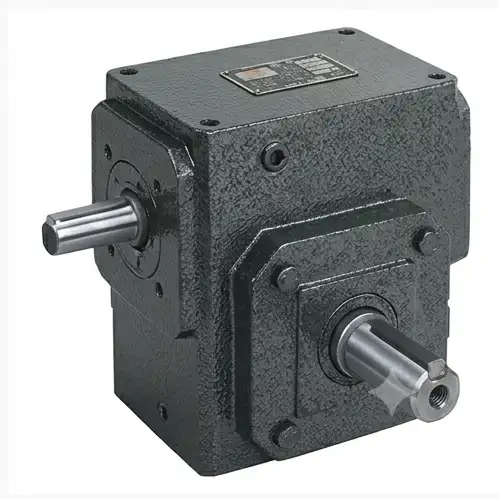
WP Series cast iron worm gearboxes in heavy industrial service — frame sizes 40 to 250, torques to 4,500 Nm
Why Heavy Industry Relies on Cast Iron Worm Gearboxes
The choice of housing material in a gearbox is not cosmetic. In heavy industrial service — where ambient temperature swings between cold starts and sustained high-load heat build-up, where shock loads from material bulk weight hit the drive system daily, and where a failed gearbox stops a production line — cast iron delivers two structural properties that aluminum cannot match at equivalent size:
Structural Rigidity Under High Worm Loads
A worm gearbox transmitting 1,000 Nm generates substantial separating and thrust forces on both the worm and wheel shafts. Cast iron’s higher stiffness maintains bearing bore alignment under these forces, preventing the micro-misalignment that generates heat and accelerates gear wear. Aluminum housing deforms measurably at the torque levels the WP Series handles in daily operation — which is why the standard switches to cast iron at frame 110 and above.
Vibration Damping in Shock Load Service
Cast iron’s internal damping capacity — its ability to absorb vibrational energy as heat within the material — is roughly 10× higher than aluminum’s. Every shock load that hits a conveyor drive, every large stone that drops into an aggregate crusher, every jerky start of a material handling system sends vibration through the drivetrain. Cast iron dissipates that vibration energy rather than transmitting it into bearing races, gear teeth, and shaft keyways.
Conveyor and Material Handling Drives
Conveyors are the most common application for WP Series gearboxes. The combination of high reduction ratio (typically 20:1 to 60:1), moderate continuous torque, and the need for a self-locking drive that holds the load when the motor de-energises makes the WP worm gearbox a natural and well-proven choice.
The self-locking property is particularly important on inclined conveyors and bucket elevators: at ratios above approximately 30:1, the worm gear pair resists back-driving under static conditions, preventing runback of the loaded belt when the motor stops. This eliminates the need for a separate backstop or brake on many conveyor designs — a significant simplification of the drivetrain.
Belt conveyors
WPA or WPO (hollow bore) on the conveyor head pulley shaft. Sizes 80–135 cover most industrial belt widths up to 1,200 mm.
Chain conveyors
WPDA (double shaft) drives two parallel chain runs from a single centrally mounted gearbox — a standard arrangement in pallet and automotive assembly conveyors.
Inclined / bucket elevators
Self-locking at 30:1+ eliminates the separate backstop needed on helical drives, reducing both capital cost and maintenance complexity.
Screw conveyors
WPO or WPX (extended housing) directly on the screw shaft, eliminating the coupling. Ratios of 20:1 to 40:1 are typical for bulk material screw transfer.
Mining, Aggregate, and Quarry Equipment
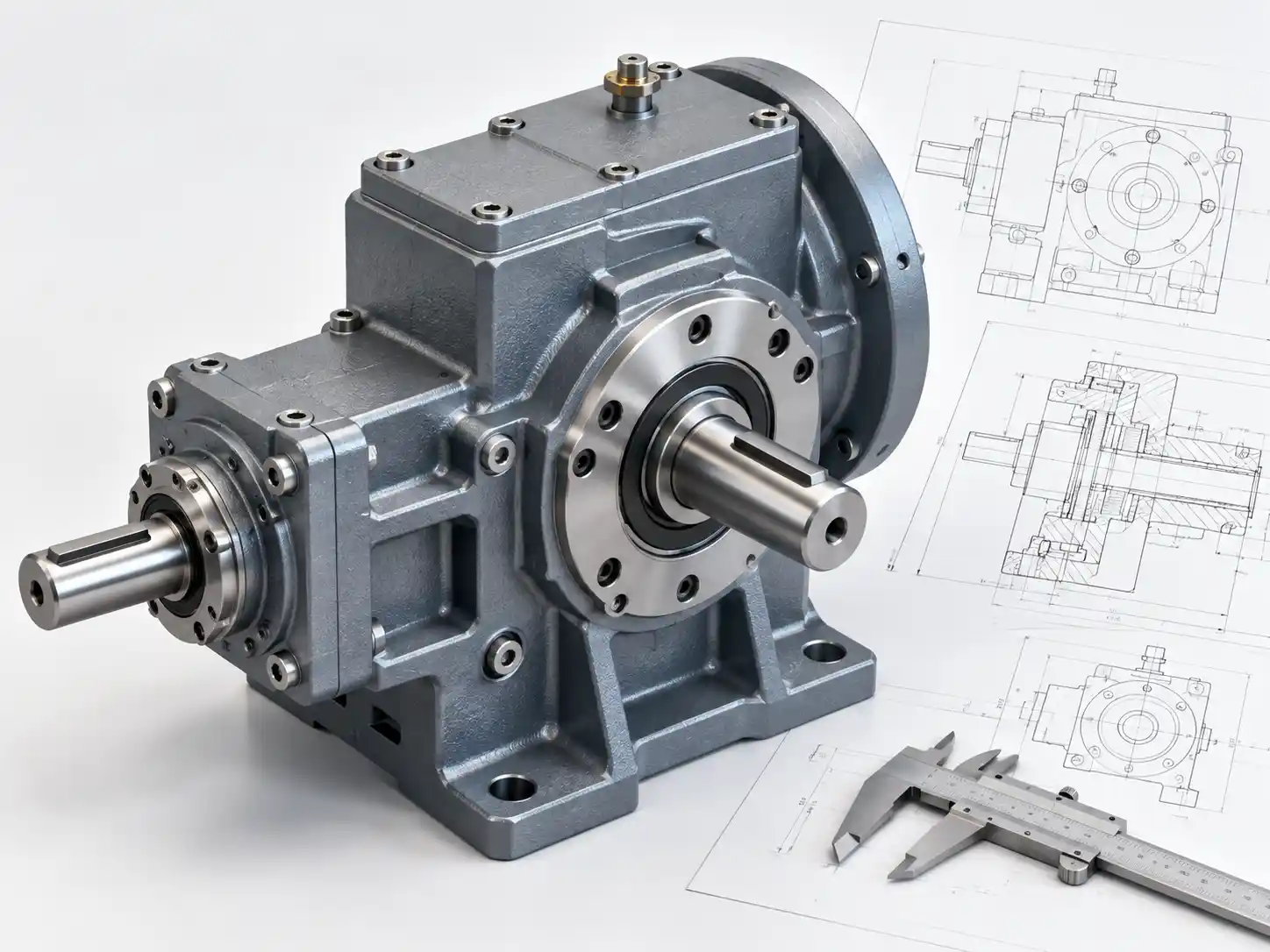
Mining and quarry applications subject drive systems to the harshest combination of conditions in any industry: extreme shock loads when large rock pieces impact crusher or feeder mechanisms, dust and grit contamination, wide temperature swings between cold morning starts and sustained high-load heat, and continuous operation with irregular maintenance access.
WP Series gearboxes in this sector are typically specified in the larger frame sizes (120–250) with service factors of 1.5 to 2.0 applied to account for shock loading. The cast iron housing’s vibration damping and structural rigidity under shock loads is the key selection driver — lighter housing alternatives fail prematurely in this environment.
- Jaw crusher auxiliary drives: Flywheel and toggle plate auxiliary drives at ratios of 5:1 to 15:1, where high torque transmission and shock resistance are the primary requirements.
- Vibrating screen drives: Low-ratio WP gearboxes (5:1 to 10:1) on eccentric mass vibrating screens, where the eccentric loading creates cyclic shock into the gearbox.
- Feeder drives: Apron feeders and belt feeders under crusher discharge points, where intermittent surge loads from large rock pieces require a gearbox with a high service factor rating.
- Conveyor head drives in underground mining: Where space is limited and a high-ratio compact worm drive is preferable to a multi-stage helical arrangement.
Metallurgical and Steel Processing

Steel mills and metallurgical processing plants demand drives that operate reliably under high ambient temperatures (from radiant heat), scale and dust contamination, and the heavy cyclic loading of rolling mill auxiliary drives. The WP Series, particularly in larger frame sizes (155–250), is used on roll table drives, pusher drives, and rotary hearth auxiliary positions where the duty cycle is sustained and the load is consistent.
Double-stage WP configurations at ratios of 200:1 to 600:1 are found on rotary kiln auxiliary drives — where a very low output speed (1–5 RPM) is required with continuous duty and high torque. The cast iron housing handles the thermal environment at the kiln perimeter better than lighter alternatives, and the self-locking property at high ratios prevents kiln runback in the event of motor failure.
High ambient temperature note: At ambient temperatures above 40°C (common near furnaces and kilns), thermal rating is the binding gearbox selection constraint — not mechanical torque. Contact our team for the thermal power derating factors for WP Series units at elevated ambient temperatures, and specify synthetic lubricant as standard in these environments.
Water Treatment and Industrial Pumping
Wastewater treatment plant equipment — surface aerators, slow-speed mixers, clarifier rakes, and sludge scrapers — operates continuously with a relatively steady, moderate torque load at very low output speeds. WP Series gearboxes at ratios of 40:1 to 100:1 (single stage) and up to 600:1 (double stage) cover the full range of output speeds required in this sector, from 30 RPM on aerator impellers down to 1–2 RPM on slow-moving clarifier mechanisms.
The outdoor installation environment — high humidity, occasional flooding in below-grade pump stations, UV exposure — is well tolerated by the cast iron housing when the standard epoxy and polyurethane protective coating is maintained. For installations with permanent water submersion risk, specify an IP65 sealed unit with enhanced shaft sealing.
Surface aerators
WPA or WPWKO (overhead) mounting driving vertical shaft aerator impellers at 20–40 RPM. Frame sizes 100–155 are typical.
Clarifier rake drives
Very slow output (1–3 RPM) on double-stage WP at 400:1 to 600:1, driving sedimentation basin rakes continuously.
Sludge and septage mixers
High-torque, low-speed mixing drives — the WP Series handles the high start-up torque of viscous sludge agitation reliably.
Screw press and dewatering
Sludge dewatering screw presses at very low speeds (5–15 RPM) under high torque — WPO hollow bore configuration is the standard fit.
Heavy Textile and Paper Mill Machinery
Paper mills and heavy textile processing plants operate drives continuously at regulated speeds — accurate output speed is often as important as torque capacity, because product quality is directly tied to linear speed consistency. WP Series gearboxes in these applications are typically at ratios of 20:1 to 60:1, paired with AC induction motors controlled by variable frequency drives to achieve precise speed regulation.
The cast iron housing’s structural rigidity is valuable here because paper and textile line speeds are set to tight tolerances — any bearing deflection caused by housing flexing under load changes the effective gear centre distance, which changes the output speed slightly and creates quality variation across a production run.
- Calender and nip roll drives: WPA foot-mounted gearboxes at 15:1 to 30:1 on heavy calender stacks in paper and nonwovens lines.
- Textile stenter frame drives: Long conveyor sections in stenter ovens driven by multiple synchronized WP gearboxes on a common shaft.
- Winding and reeling machines: WPA or WPO gearboxes at 10:1 to 20:1 on large-diameter roll winding drives, where high inertia loads require substantial starting torque.
- Pulper and broke conveyor drives: In paper mill wet-end operations, WP Series gearboxes handle the highly variable torque loads of pulped paper fibre conveyors.
Plastics Processing and Industrial Mixing
Plastics and rubber processing machinery — mixers, open-mill roll drives, internal mixer auxiliary drives, and pelletising line drives — combines the worst of several industrial environments: high viscosity materials that generate large starting torques, elevated ambient temperatures from processing heat, and continuous duty cycles with infrequent maintenance access.
WP Series gearboxes in plastics processing are typically large-frame units (size 120–250) with service factors of 1.5 applied for the torque shock that occurs when a stiff rubber batch is first engaged by the mill rolls. The combination of cast iron housing stability and the worm gear pair’s inherent smooth, shock-absorbing engagement makes the WP Series a better fit in this environment than helical-bevel gearboxes, which transmit shock loads more directly into the output structure.
WP Gearbox Service Life and Maintenance Intervals
Properly specified and lubricated, a WP Series gearbox in moderate continuous-duty industrial service has an expected service life of 20,000–30,000 operating hours before major overhaul is required. The following maintenance schedule is the basis for that service life estimate:
| Maintenance Task | Interval | Notes |
|---|---|---|
| Oil level check (oil sight glass) | Monthly | Visual check through oil mirror without draining |
| External inspection (seals, bolts, breather) | Every 3 months | Check for oil seepage, loose fasteners, blocked breather plug |
| Oil change — mineral oil | Every 3,000–5,000 h or annually | Drain while warm; flush with low-viscosity mineral oil before refilling |
| Oil change — synthetic PAG | Every 5,000–8,000 h or annually | Confirm PAG compatibility with seal material before switching from mineral oil |
| Seal replacement | Every 8,000–12,000 h | Replace proactively — seal failure causes lubricant contamination and rapid gear wear |
| Bearing and gear pair inspection | Every 15,000–20,000 h | Open and inspect for wear pattern, pitting, or scoring on worm and wheel |
Early replacement indicator: Increasing oil temperature (above the normal operating baseline for that installation), audible change in running noise, or visible oil seepage at the shaft seals are the three primary early-warning signs that a WP Series gearbox needs attention. All three are detectable without disassembly during a routine monthly check.
Specify Your WP Series Gearbox
Tell us your application, required output speed and torque, duty cycle, and mounting configuration. Our engineers will confirm the correct WP model, frame size, and service factor within 24 hours.
Frequently Asked Questions
Related Pages