
High Torque Right Angle Planetary Gearbox for Industrial Machinery: Selection and Application Guide
When the load is heavy, the duty cycle is demanding, and the machine runs continuously, gearbox selection stops being a catalog exercise and starts being an engineering problem. A high torque right angle planetary gearbox has to deliver sustained output torque at 90 degrees—handling the mechanical forces, thermal loading, and shock events that industrial machinery generates over years of operation—without becoming a maintenance liability or a failure point that stops production.
This article covers what distinguishes a genuinely high-torque capable right angle planetary gearbox from a standard unit pushed beyond its intended envelope, how to size one correctly for industrial duty, and what to watch for in applications where torque requirements are close to or at gearbox limits.
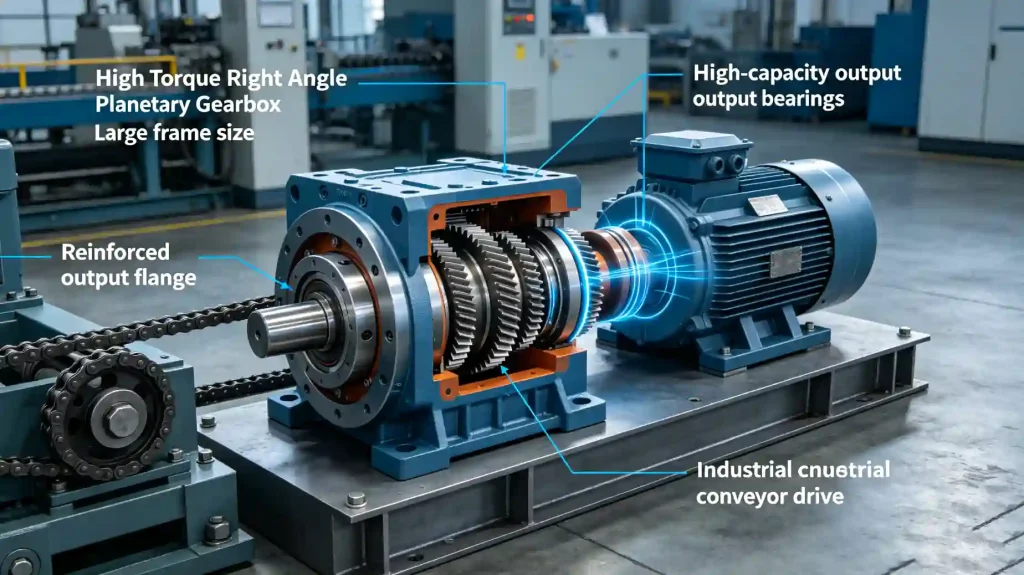
What “High Torque” Actually Means in This Context
High torque is relative. A 50 Nm gearbox is high torque for a packaging machine indexer and completely inadequate for a cross-feed drive on a steel plate processing line. The term matters less than the actual rated output torque relative to what the application demands—and whether that rating is backed by the thermal capacity, bearing design, and gear geometry to sustain it continuously under real operating conditions.
In right angle planetary gearboxes, output torque scales with frame size. Larger housings accommodate larger planet gears, larger sun gears, larger output bearings, and larger bevel gear sets—all of which increase torque capacity. The planetary stage’s distributed load-sharing across three or more planet gears gives it a fundamental torque density advantage over single-mesh designs: three gear contacts sharing the load instead of one means more torque per unit of housing volume.
For heavy industrial applications, the relevant torque values are typically in the range of several hundred to several thousand Newton-meters at the output. At these torque levels, every element of the gearbox—gear tooth geometry, bearing selection, housing rigidity, lubrication system, and sealing—has to be engineered for sustained high-load operation, not just peak capability.
How High Torque Changes the Selection Calculus
At high output torque levels, several selection factors become more critical than they are in lighter-duty applications.
Service factor application becomes less forgiving. On a light-duty conveyor, using a service factor of 1.25 instead of 1.5 might mean the gearbox runs slightly warmer than ideal—a minor inconvenience. On a heavy industrial drive at high base torque, the same underestimation means the gearbox runs in or above its thermal rating, accelerating lubricant degradation and reducing bearing life significantly. For heavy-duty industrial applications, service factors of 1.75–2.5 are common, and the calculation should be done conservatively.
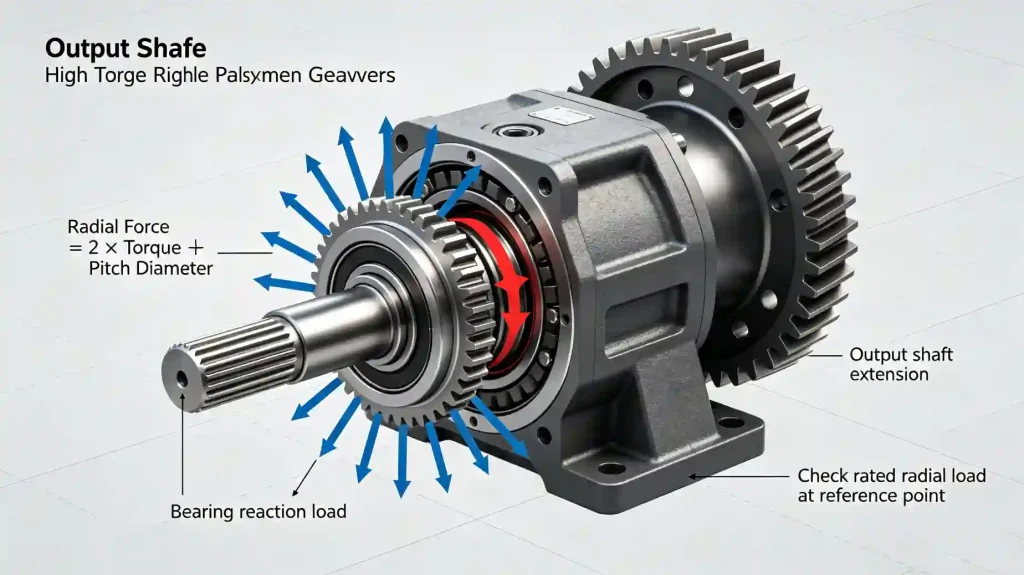
Radial and axial load ratings become binding constraints. High output torque usually means large sprockets, large pinions, or significant drive forces—all of which generate substantial radial loads on the output shaft bearing. The output bearing radial load rating must be checked explicitly against the calculated radial force. Many gearbox failures in high-torque industrial applications trace back not to gear tooth overload but to output bearing failure from radial load that was never calculated.
Thermal management is a real design consideration. High torque at high duty cycle generates significant heat in the gear mesh. The gearbox housing dissipates this heat to the surrounding environment. In restricted or high-ambient-temperature installations, the thermal rated torque—not the mechanical rated torque—may be the governing limit. At continuous full-load operation in a 40°C ambient environment, some gearboxes must be derated significantly from their nameplate rated torque. Check the thermal rating explicitly for your operating conditions.
Shock and impact loading matters more. Industrial machinery—presses, shredders, material handling equipment, rolling mills—often generates torque spikes from impact loads, jams, or sudden load changes that can be multiples of the continuous torque. The gearbox peak torque rating must account for these events. In applications with unpredictable impact loading, a higher safety margin above peak torque rating is prudent.
Frame Size, Ratio, and the Torque Rating Relationship
Within a right angle planetary gearbox product family, rated output torque is primarily a function of frame size and gear ratio. Larger frames deliver higher torque. But the relationship between ratio and rated torque within a single frame is not always monotonic—and this catches engineers out regularly.
In two-stage designs at very high ratios, the first planetary stage may operate at a higher speed than the second, and the first stage’s gear teeth see a higher number of load cycles per unit time. This can reduce the effective rated torque at very high ratios compared to the same frame at lower ratios. Some manufacturers publish ratio-specific torque ratings in their datasheets; others publish a single rated torque for the frame size. When the published data isn’t explicit, ask the manufacturer for the rated torque at your specific ratio before finalizing the selection.
It’s also worth noting that the bevel input stage has its own torque limit, separate from the planetary output stage. In very high-torque applications, the bevel stage is sometimes the limiting element rather than the planetary stage. The output torque rating in the datasheet should account for both stages—but for applications near the top of the frame’s torque range, it’s worth confirming this explicitly.
| Application Type | Typical Output Torque Range | Key Selection Concern |
|---|---|---|
| Conveyor cross-drives, medium duty | 50–300 Nm | Radial load from sprocket drives |
| Heavy conveyor and haulage drives | 300–1,500 Nm | Thermal rating at high duty cycle |
| Rolling mill auxiliary drives | 500–3,000 Nm | Peak torque from roll engagement shock |
| Industrial mixer and agitator drives | 200–2,000 Nm | Continuous duty thermal management |
| Material shredding and size reduction | 1,000–5,000+ Nm | Extreme shock and jam loading |
Lubrication at High Torque and High Duty Cycle
Smaller servo-grade right angle planetary gearboxes are often lifetime-lubricated with grease—sealed for life, no oil service required. At the torque and power levels typical of heavy industrial drives, oil lubrication is more common. Oil has higher thermal capacity than grease, circulates through the gearbox to carry heat away from gear meshes and bearings, and can be monitored and changed as part of a planned maintenance program.
For oil-lubricated units, the oil grade, oil quantity, and oil change interval are specified in the manufacturer’s documentation for each model. These values must be followed—using the wrong oil viscosity, overfilling, or underfilling all affect gearbox performance and service life. The change interval depends on operating temperature and duty: a gearbox running at high load in a warm environment needs more frequent oil changes than the same unit running at moderate load in a cool one.
Mounting orientation affects oil lubrication behavior. The oil level and breather plug positions shown in the installation drawing assume the default mounting orientation. If the gearbox is mounted differently—vertically, inverted, or wall-mounted—the oil level must be adjusted and the drain and breather plug positions reconfigured accordingly. Failing to do this can result in oil starvation of critical bearings or oil flooding of shaft seals, both of which cause premature failure. Always confirm the lubrication configuration for your specific mounting orientation with the manufacturer’s installation drawing.
Output Shaft Loading in Heavy Industrial Drives
At high output torque, the forces transmitted through the output shaft coupling are large. A gearbox delivering 1,000 Nm through a 0.15 m pitch radius sprocket generates a radial force of approximately 13,300 N at the sprocket. That force is applied to the output shaft extension, creating a bending moment that the output shaft bearing must react against.
The rated radial load in the gearbox datasheet is specified at a reference point on the output shaft—typically at the midpoint of the shaft extension or at a specified distance from the output bearing face. If the actual driving component is mounted further out on the shaft than this reference point, the effective moment load on the bearing is higher, and the allowable radial force is lower. This relationship is not always intuitive; consult the manufacturer’s shaft loading diagram for the specific gearbox model.
For very high radial loads, output flange configurations—where the driven component bolts directly to a precision flange face on the gearbox housing rather than to a shaft extension—distribute the moment load more effectively and typically allow higher radial force capacity than equivalent shaft output configurations. For applications where the radial load is a binding constraint, an output flange or hollow shaft design may be the solution.
Sealing and Environmental Protection
Heavy industrial environments are often hostile to gearbox seals—dust, water, wash-down chemicals, high-pressure cleaning, and temperature extremes all challenge seal integrity. IP protection ratings quantify how well the gearbox is sealed against ingress.
Standard right angle planetary gearboxes are typically rated IP65 or IP67—protected against dust and against water jets or temporary immersion respectively. For food processing, outdoor installations, underground mining, or high-pressure wash-down environments, IP67 or IP69K rated units are appropriate. The sealing specification is particularly important for the output shaft—this is where the oil seal is most exposed to external contamination and where seal failure leads directly to lubricant loss and bearing damage.
At high output torques, the output shaft seal operates under greater dynamic stress—higher shaft surface speed at the seal lip if the output speed is moderate to high, combined with higher differential pressure from oil head in certain mounting orientations. Seal life is finite; monitoring for oil seepage at the output shaft is a standard part of any maintenance inspection on a high-torque gearbox in continuous operation.
Signs a High-Torque Right Angle Gearbox Is Being Overloaded
Overloading a gearbox rarely announces itself immediately. The damage accumulates. Here’s what to watch for:
- Housing temperature above normal. A gearbox running consistently hotter than its design temperature—whether from overload, insufficient lubrication, or high ambient—is accumulating damage. For oil-lubricated units, measuring oil temperature directly is more informative than touching the housing.
- Increasing noise from the gear mesh. A gradual increase in operational noise—particularly a periodic clicking or rumbling that wasn’t present at commissioning—indicates gear tooth or bearing wear that’s proceeding faster than it should.
- Oil contamination or darkening. Oil that turns dark, metallic, or develops a burnt smell is under thermal stress and may contain wear particles. Oil analysis at scheduled intervals is a cost-effective early warning system for heavy industrial gearboxes.
- Oil seal weeping. Elevated operating temperature accelerates seal lip degradation. An oil seal that starts to seep at the output shaft before the expected replacement interval is a sign of thermal overload.
- Backlash increase faster than expected. Accelerated gear tooth wear from overloading increases backlash at a rate disproportionate to operating hours. If backlash measurements at scheduled inspections show rapid growth, revisit the torque loading calculation.
Frequently Asked Questions
How do I know if I need a high-torque gearbox versus a standard unit?
Calculate your required output torque, apply the appropriate service factor for your application type, and compare the result to the gearbox rated torque. If the required torque (after service factor) exceeds the rated torque of a standard unit in the frame size that fits your envelope, you need a larger frame or a higher-rated product. “High torque” is simply the description for units whose frame size delivers the torque rating your application needs.
Can a right angle planetary gearbox handle shock loading from a press or shredder?
Yes, if the gearbox is correctly sized for the peak torque including shock events. Planetary gear trains handle transient peak loads well due to multi-mesh load sharing, but the peak torque rating must still exceed the maximum instantaneous torque the machine generates. For shredding, pressing, or other high-impact applications, service factors of 2.0–2.5 or higher are typically applied to the continuous torque rating, and the peak torque rating must be confirmed independently against the estimated maximum impact torque.
Is oil lubrication required for high-torque right angle planetary gearboxes?
Not universally—it depends on the specific frame size, torque level, and duty cycle. Many precision servo gearboxes up to moderate torque levels use lifetime-lubricated grease and require no oil service. At higher torque levels and high continuous duty cycles, oil lubrication provides better thermal management. The manufacturer’s specifications for the specific model and operating conditions determine which lubrication approach is appropriate.
What is the maximum output torque available in a right angle planetary gearbox?
This varies significantly by manufacturer and product line. Precision servo-grade right angle planetary gearboxes typically top out in the range of 2,000–5,000 Nm for the largest standard frame sizes. Heavy industrial right angle planetary drives can reach higher values. For very high torque requirements, confirm the specific product range available with the supplier for your application.
How often should oil be changed in a high-torque industrial right angle planetary gearbox?
Oil change intervals depend on operating temperature, duty cycle, oil type, and the manufacturer’s recommendations for the specific model. As a general orientation: initial oil change is often recommended after a break-in period (typically 500–1,000 operating hours), then at regular intervals thereafter—commonly every 2,000–5,000 hours depending on operating conditions. Refer to the model-specific maintenance manual; don’t apply a generic interval without confirming it against the manufacturer’s data for your unit.
Can I use a high-torque right angle planetary gearbox in a vertical mounting orientation?
Most designs support vertical mounting, but lubrication configuration must be adjusted for the orientation. Oil level, breather plug position, and drain plug position are all orientation-dependent for oil-lubricated units. For grease-lubricated units, orientation is generally less critical. Always confirm the mounting orientation is supported and review the installation drawing for orientation-specific lubrication requirements before commissioning.
Specifying a High Torque Right Angle Planetary Gearbox
For industrial applications where the torque requirement is large, the duty cycle is demanding, or the operating environment is harsh, getting the gearbox specification right at the design stage avoids costly field failures and unplanned downtime. The selection starts with accurate torque data—calculated from actual load forces, not estimates—and works through service factor, peak torque, radial load, thermal rating, and environmental protection in sequence.
For Canadian OEMs and industrial equipment manufacturers, high torque right angle planetary gearbox selection support is available through EPG Canada.
EPG Canada Sales Representative Co., Ltd
Email: [email protected]
Phone: +1-604 719 2870
Address: 10891 Hogarth Dr, Richmond, BC V7E 3Z9, Canada
For high-torque applications, send: drive motor power and speed; calculated continuous output torque and peak torque; application type and duty cycle; daily operating hours; ambient temperature; radial and axial loads at the output shaft; mounting orientation; output configuration (shaft, flange, or hollow shaft); IP protection requirement; and any existing gearbox nameplate data for replacement projects. See the full planetary gearbox range or contact us directly.