
Low Backlash Right Angle Planetary Gearbox: What It Means and When You Actually Need It
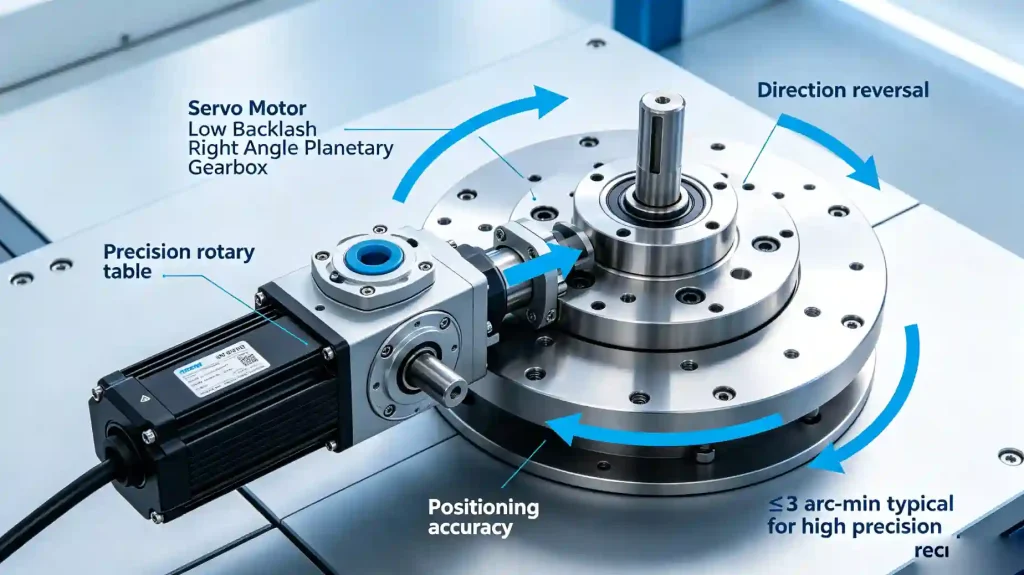
Low backlash is one of those specifications that sounds universally desirable—like asking whether you want better or worse. But in practice, specifying tighter backlash than your application requires costs money, sometimes quite a lot of it, without delivering any measurable benefit. And specifying too loose a class causes positioning errors that compound with every direction reversal the machine makes.
This article explains what backlash actually is in a right angle planetary gearbox, how it’s measured, what drives the cost of reducing it, and—most importantly—how to determine what backlash class your specific application actually needs.
What Backlash Is—and Where It Comes From
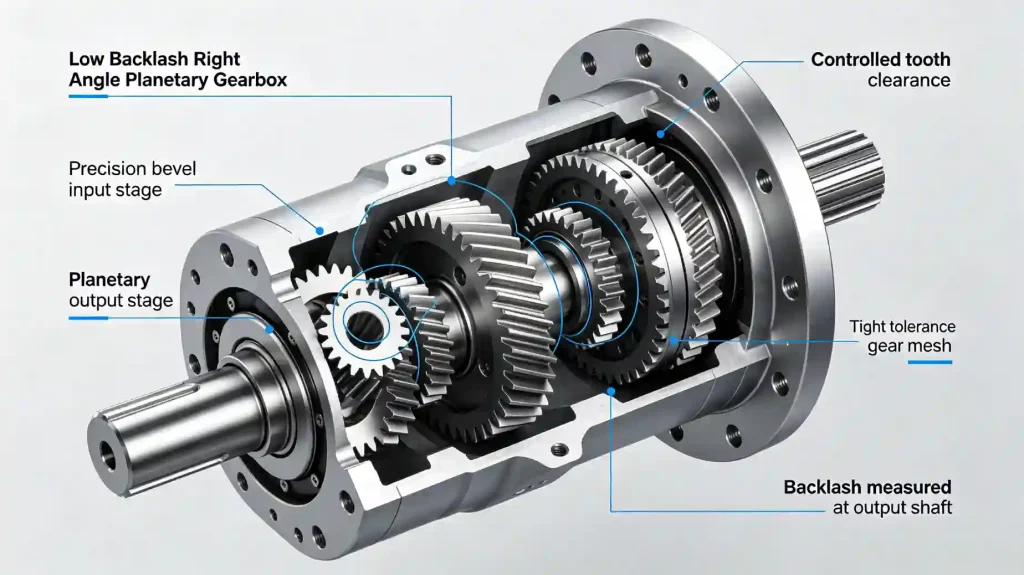
Backlash is the angular play at the output shaft when the input is held stationary and no torque is applied. Hold the motor coupling fixed, grab the output shaft, and rotate it back and forth: the total angular movement before the gears engage in either direction is the backlash. It’s measured in arc-minutes—one arc-minute being 1/60 of one degree.
In a right angle planetary gearbox, backlash originates at two places: the spiral bevel gear mesh at the input stage, and the planetary gear mesh at the output stage. Both contribute to total output backlash. The bevel stage typically contributes the larger share, because bevel gears are harder to manufacture to the same tooth-to-tooth precision as ground planetary gears, and because the bevel mesh geometry involves more sensitivity to tooth clearance.
Backlash exists because gears need a small clearance between meshing teeth—if they were machined to zero clearance, thermal expansion alone would cause the gears to bind. The engineering challenge is minimizing that clearance while keeping the gearbox manufacturable and reliable. Getting below 3 arc-min in a right angle planetary gearbox requires precision-ground bevel gears, tight manufacturing tolerances throughout the assembly, and careful shimming—all of which adds cost.
How Backlash Is Specified and Measured
Manufacturers specify backlash as a maximum value at the output shaft, typically under a defined light test load (to take up bearing clearances without deflecting the gears under torque). The measurement is done on a test rig with the input held and a torque arm applied to the output. The result is the total angular movement in arc-minutes.
What the spec doesn’t always tell you: backlash increases over time as gear teeth wear. A gearbox shipped at 4 arc-min will not stay at 4 arc-min indefinitely. Under normal operating conditions with proper lubrication, the increase is gradual—but in high-cycle applications with heavy loads, backlash growth can be meaningful over a machine’s lifetime. For tight-tolerance applications, this wear margin should factor into the initial backlash class selection.
Also worth noting: total system backlash includes contributions from the gearbox, the coupling between motor and gearbox, the coupling between gearbox and driven component, and any mechanical play in the driven mechanism itself. Specifying a ≤1 arc-min gearbox on a drivetrain with a 15 arc-min jaw coupling on the output side is a waste of money. The gearbox backlash is only one element of the total positional error budget.
Backlash Classes in Practice
Most manufacturers organize their right angle planetary gearboxes into backlash grades. The terminology varies—some use “standard,” “precision,” and “high precision”; others use numeric grades or arc-minute ranges directly. The underlying tiers look roughly like this across the industry:
| Grade | Typical Backlash | Representative Applications |
|---|---|---|
| Standard | 8–15 arc-min | Conveyors, mixers, unidirectional drives, general material handling |
| Reduced | 5–8 arc-min | Packaging lines, light automation, moderate reversing duty |
| Precision | 3–5 arc-min | Indexing, pick-and-place, collaborative robotics, assembly automation |
| High Precision | ≤3 arc-min | CNC rotary axes, articulated robots, precision servo positioning |
| Ultra Precision | ≤1 arc-min | Optical systems, metrology equipment, advanced motion stages |
The practical cost jump is largest between the precision and high-precision tiers. Achieving ≤3 arc-min in a right angle planetary gearbox requires precision-ground bevel gears—an expensive manufacturing step—alongside tightly controlled planetary stage geometry. Below 1 arc-min, the manufacturing process becomes even more selective and assembly is labor-intensive. The cost premium is real. Don’t pay for it unless the application needs it.
How to Determine the Backlash Class Your Application Needs
Start with the positioning accuracy requirement at the load, then work backwards through the drivetrain to determine how much of that error budget the gearbox can consume.
Say your application requires the output shaft to position to within ±0.1 degrees. One arc-minute is approximately 0.017 degrees. So ±0.1 degrees = ±6 arc-min of allowable positioning error. Half of that budget might be allocated to the gearbox backlash, giving a gearbox backlash requirement of around 6 arc-min. A standard or reduced-grade gearbox likely works here.
If the requirement is ±0.02 degrees (±1.2 arc-min), the gearbox backlash needs to be significantly below that—a high-precision or ultra-precision unit is necessary, and the rest of the drivetrain must be equally tight.
A few application-specific considerations:
- Unidirectional loads don’t need ultra-low backlash. If the load is always driven in one direction and never reverses—a conveyor, a one-way winding drive—backlash doesn’t accumulate as positioning error. Standard or reduced grade is typically fine regardless of the application’s nominal precision requirement.
- Closed-loop servo control reduces but doesn’t eliminate the effect of backlash. A servo drive with a load-side encoder can compensate for some backlash by hunting to position after direction reversals. But this takes time, creates dwell, and puts servo tuning stress on the system. Lower backlash gives the servo less to compensate for and usually results in better dynamic performance and cleaner motion profiles.
- High-cycle reversing duty accelerates backlash wear. An application with thousands of direction reversals per day stresses the gear tooth contacts more than steady unidirectional operation. For high-cycle reversing applications, start with a tighter backlash grade than the nominal accuracy requirement alone would suggest.
- Long output shaft extensions amplify angular error. If the driven component is at the end of a long shaft extension, a small angular error at the gearbox output becomes a larger linear error at the load. Factor this amplification into the backlash budget.
Why Right Angle Planetary Gearboxes Achieve Lower Backlash Than Worm or Standard Bevel Units
The planetary gear stage is the key. Planet gears can be manufactured to tight tolerances and their tooth geometry allows fine control of mesh clearance through bearing preload and gear sizing. The ring gear and sun gear can be precision-ground. Assembling three planets with equal load distribution enforces geometric consistency that a single-mesh gear pair can’t achieve.
The bevel stage in a right angle planetary gearbox is the more challenging element for backlash control. Bevel gear tooth contact is inherently sensitive to axial positioning—small variations in the bevel pinion’s axial location change the tooth clearance significantly. Precision bevel stage backlash is achieved through precision-ground bevel gear sets, tight tolerances on the housing bore that locates the bevel pinion bearing, and sometimes shimming during assembly to hit a specific backlash value. This is manufacturing-intensive, which is why low-backlash right angle units cost more than equivalent inline planetary gearboxes at the same backlash specification.
Backlash vs. Torsional Rigidity: Related but Different
Engineers sometimes conflate backlash and torsional rigidity, but they measure different things. Backlash is the lost motion at zero torque—the freeplay before the gears engage. Torsional rigidity is how much the gearbox output twists when torque is applied, even after the gears are fully engaged.
A gearbox can have low backlash but relatively low torsional rigidity—it snaps to position quickly after a reversal, but the output winds up measurably under high torque. Conversely, a stiff gearbox with higher backlash holds its position firmly under load but loses accuracy at direction reversals.
For servo positioning applications, both matter. Backlash affects accuracy at direction reversals. Torsional rigidity affects accuracy under varying load torque. In planetary gearboxes, the distributed load-sharing of the planetary stage gives inherently high torsional rigidity—higher than worm or bevel-only designs at equivalent frame sizes. Low-backlash precision planetary gearboxes typically combine both: tight freeplay and high torsional stiffness. Datasheets usually specify torsional rigidity in Nm/arc-min alongside the backlash specification.
The Cases Where Low Backlash Doesn’t Help
It’s worth being direct about this. Specifying a ≤3 arc-min right angle planetary gearbox doesn’t help if:
- The coupling between motor and gearbox introduces 10 arc-min of its own compliance.
- The driven mechanism—a chain drive, a rack and pinion with worn teeth, a loose coupling on the output side—has more play than the gearbox.
- The application runs unidirectionally and position accuracy is only required in one direction of approach.
- The servo drive’s position feedback comes from the motor encoder rather than a load-side encoder, and mechanical play elsewhere in the drivetrain is outside the control loop anyway.
Low gearbox backlash is one element of a low-backlash drivetrain. The weakest link in the positional error chain sets the system’s effective accuracy. Optimizing the gearbox backlash in isolation, without reviewing the whole drivetrain, rarely delivers the expected improvement in system positioning performance.
Frequently Asked Questions
What is a typical backlash value for a low backlash right angle planetary gearbox?
Precision-grade right angle planetary gearboxes are typically specified at ≤5 arc-min or ≤3 arc-min. High-precision variants reach ≤1 arc-min. “Low backlash” as a term covers a range—always check the specific arc-minute value in the product datasheet rather than relying on grade labels alone.
Does backlash matter if I’m using a servo motor with a closed-loop encoder?
Yes—but how much depends on whether the encoder is on the motor (input side) or on the load (output side). With a motor-side encoder, the servo drive cannot see or correct for backlash between the gearbox output and the load. With a load-side encoder, the drive can compensate, but the compensation involves hunting that takes time and stresses the servo. Lower backlash simplifies servo tuning and generally improves dynamic performance regardless of encoder placement.
How much does low backlash increase the cost of a right angle planetary gearbox?
The cost premium varies by manufacturer and frame size, but moving from standard grade (8–15 arc-min) to precision grade (≤3 arc-min) in a right angle planetary gearbox typically increases unit cost meaningfully—often 30–80% or more depending on the frame size and the specific product line. Ultra-precision grades (≤1 arc-min) carry larger premiums still. Confirm pricing with the supplier for your specific frame size and ratio.
Does backlash get worse over time?
Yes. Gear tooth wear increases the tooth clearance and therefore the backlash over the gearbox’s service life. The rate depends on load, lubrication quality, operating temperature, and duty cycle. Proper lubrication and not exceeding torque ratings are the most effective ways to slow backlash growth. For applications that require backlash to stay within a tight tolerance over time, periodic measurement and the option to re-shim or replace the unit should be factored into the maintenance plan.
Is a low backlash right angle planetary gearbox the same as a zero-backlash gearbox?
No. True zero-backlash gearboxes—strain wave gears (harmonic drives), cycloidal reducers with preloaded elements—use fundamentally different gear mechanisms. Planetary gearboxes have a practical minimum backlash set by manufacturing tolerances and the need for thermal expansion clearance. ≤1 arc-min is achievable in precision planetary designs; true zero is not, and gearboxes marketed as “zero backlash” planetary units typically mean very low rather than literally zero.
Can I specify a custom backlash value not listed in the standard grades?
Some manufacturers offer custom assembly to a specific backlash target for volume orders or special applications. For standard catalog orders, the grade tiers available are fixed. If your requirement falls between standard grades, specify the next tighter available grade—don’t try to make a looser grade work by assuming it might meet the tighter spec.
Specifying the Right Backlash Grade for Your Application
The right low backlash right angle planetary gearbox is the one that meets your application’s actual positional accuracy requirement—not the tightest available. Working out the appropriate backlash specification is part of the selection process, and it’s worth getting right before ordering.
EPG Canada Sales Representative Co., Ltd provides gearbox selection support for Canadian OEMs and industrial equipment manufacturers across North America. If you need help determining the appropriate backlash grade for your application—or want to confirm whether a standard-grade unit will work before paying for precision—send us the details.
Email: [email protected]
Phone: +1-604 719 2870
Address: 10891 Hogarth Dr, Richmond, BC V7E 3Z9, Canada
Useful information to include: required positioning accuracy at the load (degrees or mm), direction of motion (unidirectional or reversing), duty cycle and cycle frequency, encoder placement (motor-side or load-side), and any existing backlash issues with a current installation. See the full planetary gearbox range or go directly to the right angle planetary gearbox series. Contact us here to start the conversation.