
Right Angle vs Inline Planetary Gearbox: Which One Do You Actually Need?
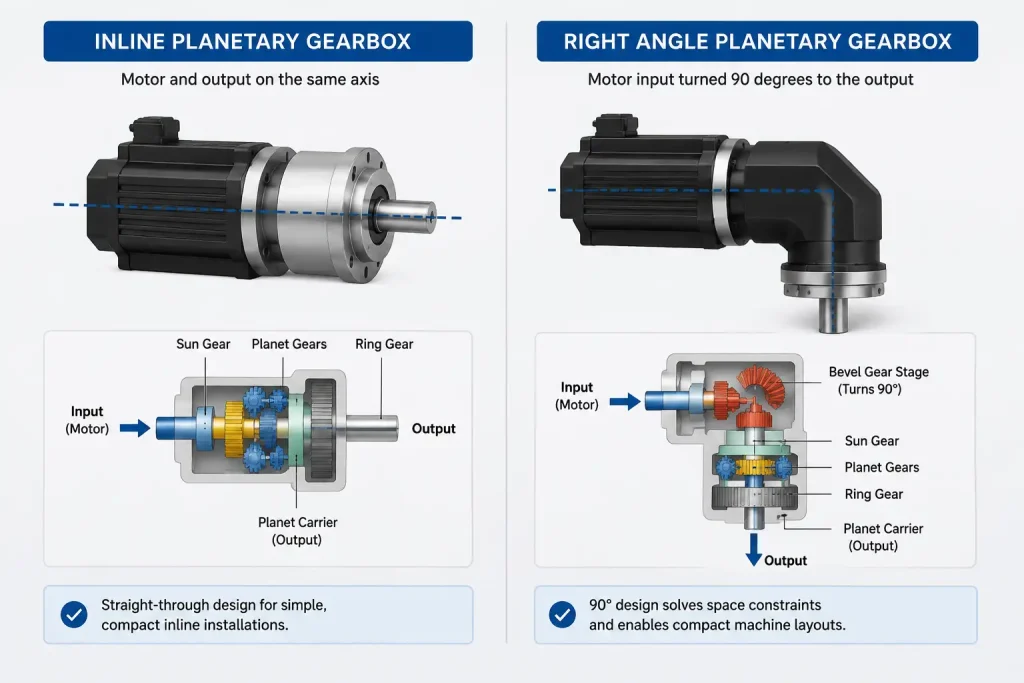
Both are planetary gearboxes. Both use a sun gear, planet gears, a ring gear, and a planet carrier. Both deliver high torque density in a compact package. The difference is one thing: what happens at the input. An inline planetary gearbox takes the motor shaft and keeps it on the same axis as the output. A right angle planetary gearbox takes the motor shaft and turns it 90 degrees before it reaches the planetary stage.
That sounds like a simple mechanical distinction—and it is. But the implications for machine design, installation envelope, servo performance, efficiency, and cost are real enough that choosing the wrong configuration creates problems that can’t be fixed without a redesign. This article covers when each type makes engineering sense, and what the actual tradeoffs are.
How Each Configuration Works
An inline planetary gearbox connects directly to the motor with the input and output shafts collinear. The motor drives the sun gear. The planet gears orbit the sun gear while meshing with the fixed ring gear. The planet carrier rotates and drives the output shaft. The whole assembly is a straight cylinder—motor on one end, output on the other.
A right angle planetary gearbox adds a spiral bevel gear stage between the motor input and the planetary stage. The motor drives a bevel pinion, which meshes with a bevel ring gear on a perpendicular shaft. That perpendicular shaft then drives the sun gear of the planetary stage. Output comes off the planet carrier, now running at 90 degrees to the original motor axis.
Everything else—the planetary gear train, the output shaft or flange options, the bearing arrangement, the backlash specification, the IP sealing—is essentially the same class of hardware.
The Core Differences That Actually Matter
| Parameter | Inline Planetary | Right Angle Planetary |
|---|---|---|
| Motor-to-output axis | Collinear (same axis) | Perpendicular (90°) |
| Transmission efficiency | Typically 97–99% per stage | Typically 94–97% overall (bevel loss adds ~2–4%) |
| Backlash | Lower potential (planetary stage only) | Slightly higher (bevel + planetary contribute) |
| Overall assembly length | Longer in the motor axis direction | Shorter in the motor axis; wider perpendicular |
| Cost | Generally lower | Higher (bevel stage adds complexity and cost) |
| Machine layout flexibility | Limited to inline drive configurations | Solves 90° layout constraints directly |
| Noise level | Lower (no bevel mesh) | Slightly higher (spiral bevel adds some noise) |
| Inertia matching | Same principle, no bevel inertia added | Bevel stage adds slight rotor-side inertia |
When to Use an Inline Planetary Gearbox
If your machine layout allows the motor and the driven load to sit on the same axis, an inline planetary gearbox is almost always the better starting point. Here’s why:
It’s simpler. Fewer gear meshes means fewer sources of backlash, slightly higher efficiency, and marginally lower noise. For precision servo applications where you’re already at the limits of achievable backlash—say, ≤1 arc-min—eliminating the bevel stage gives you the best possible starting point for the planetary stage to work with.
It’s also typically less expensive in equivalent frame sizes, because the bevel gear set is precision-ground hardware that adds real cost to the right angle variant.
Inline is the right choice when:
- Motor and output shaft are on the same axis by design—ballscrew drives, direct-coupled conveyors, linear axis servo drives.
- You need the absolute lowest possible backlash at the lowest cost.
- Noise and vibration are a critical concern and every source should be minimized.
- Efficiency is a primary factor—high-cycle applications or continuous-duty systems where a 2–4% difference in efficiency translates to real thermal or energy cost.
- The machine frame has adequate depth in the motor axis direction.
When to Use a Right Angle Planetary Gearbox
The clearest case: the driven shaft and the motor shaft cannot be on the same axis. Full stop. If the machine layout puts the output axis perpendicular to where the motor needs to sit, a right angle planetary gearbox solves the problem in one unit, without external bevel gear sets, without additional shaft assemblies, without added alignment points.
But there are also cases where the right angle design is chosen even when an inline unit could theoretically work—because the layout benefit outweighs the slight performance tradeoff:
- Compact machine frames where the motor must fold alongside the machine rather than extending outward. A right angle unit can dramatically reduce the machine footprint in the drive axis direction.
- Conveyor and material handling systems where drive motors are mounted parallel to the conveyor frame and the output shaft runs perpendicular into a drive shaft or roller.
- Rotary table drives where the servo motor mounts vertically and the output drives a horizontal table axis.
- Gantry systems with cross-axis drives where motor placement parallel to the beam is the only practical option.
- Replacement projects where the existing machine uses a right angle gearbox and the drive envelope is fixed.
A right angle planetary gearbox is not a compromise solution. It’s a specific mechanical configuration that solves specific layout problems with the same torque density and precision capability as its inline counterpart—just with the 90-degree turn built in.
The Efficiency Difference: Does It Actually Matter?
This comes up often. An inline planetary gearbox at 98% efficiency vs a right angle unit at 95%—is that a real concern?
For most industrial applications, no. A 3% efficiency difference on a 1 kW motor is 30 W. That’s heat, not a system-level problem. Even on a 10 kW drive, 300 W of additional heat loss is manageable with proper thermal design.
Where efficiency starts to matter: very high-cycle continuous-duty applications running 24 hours a day, 365 days a year, where energy cost and thermal management are actively budgeted. Or applications in thermally constrained enclosures where every watt of additional heat generation is a problem.
For everything else—packaging machines, conveyor drives, assembly automation, CNC axes—the efficiency difference is not a valid reason to force an inline layout when a right angle unit is the better mechanical fit.
The Backlash Difference: Practical Perspective
Inline planetary gearboxes can achieve lower backlash more easily because backlash comes from one source: the planetary stage. Right angle units have two sources: the bevel mesh and the planetary stage. Both can be precision-ground to low-backlash specifications, but it takes more precision at both meshes to achieve the same overall result.
In practice: a precision-grade right angle planetary gearbox can achieve ≤3 arc-min backlash. Ultra-precision variants can reach ≤1 arc-min. These are the same target specifications available in inline designs—they just require tighter manufacturing tolerances at the bevel stage and cost more to achieve than equivalent inline units.
If your application needs ≤1 arc-min and the layout allows inline mounting, use inline. If the layout demands a right angle unit and you need ≤3 arc-min, a precision right angle planetary gearbox delivers it. Don’t assume you have to compromise on backlash just because you need a 90-degree turn.
What About Using an Inline Gearbox With an External Bevel Set?
Some engineers try to solve the 90-degree layout problem by using an inline planetary gearbox followed by a separate external bevel gear set. This works mechanically, but it introduces additional complexity:
- An extra shaft assembly with its own bearings, housing, and alignment requirements.
- An additional backlash source at the external bevel mesh, which is often less tightly controlled than a precision bevel stage integrated into the gearbox.
- More parts to install, align, and maintain.
- A larger overall assembly footprint than a purpose-built right angle planetary unit.
A right angle planetary gearbox integrates all of this into a single precision housing. It’s not always cheaper than a separate arrangement, but it’s almost always more compact, more precise, and easier to install and maintain.

How to Make the Final Call
Work through these questions in order:
- Does the machine layout require a 90-degree drive direction change? If yes, use a right angle planetary gearbox. There is no equivalent inline solution.
- Is the layout flexible? If you can run either inline or right angle, move to the next questions.
- Is backlash the most critical factor and must it be ≤1 arc-min? Inline is easier and less expensive to achieve this specification.
- Is the machine space-constrained in the motor axis direction? A right angle unit reduces the drive assembly length significantly—sometimes by the full motor body length.
- Is this a replacement for an existing unit? Match the existing configuration. Changing from right angle to inline typically means redesigning the machine frame.
- Is efficiency a primary operating cost concern? Inline is the better choice if continuous-duty thermal management or energy cost is a key design constraint.
In most real applications, the answer to question 1 settles it. Machine layouts drive gearbox configuration choices far more often than efficiency curves or backlash spec sheets.
Frequently Asked Questions
Can I replace an inline planetary gearbox with a right angle unit?
Mechanically, yes—but the motor mounting position and output shaft orientation will change by 90 degrees. This typically requires redesigning the machine mounting arrangement. It’s not a drop-in swap unless the machine was specifically designed to accommodate both configurations.
Is the torque rating the same between inline and right angle planetary gearboxes of the same frame size?
Not always. The planetary stage determines most of the torque rating, so a right angle unit with the same planetary stage as an inline unit should have a similar rated torque. However, the bevel stage also has its own torque limit, and in some designs the bevel stage is the limiting factor. Check the rated torque on the output—not just the frame size—when comparing.
Do right angle planetary gearboxes have higher noise than inline units?
Slightly, in most cases. The spiral bevel stage adds a mesh frequency that inline units don’t have. For most industrial applications, the difference is not meaningful. For noise-sensitive environments—medical equipment, laboratory automation, clean rooms—this is worth factoring in.
Which type is better for servo motor applications?
Both are used extensively with servo motors. The inline configuration is more common for linear axis drives (ballscrews, rack and pinion). The right angle configuration is more common for rotary table drives, conveyor cross-drives, and gantry systems. The selection depends on the axis geometry, not on servo compatibility.
Are gear ratios the same between inline and right angle units?
The planetary stage ratios are the same. In right angle designs, the bevel stage typically adds a 1:1 ratio at the input (direction change only), though some designs incorporate a slight reduction at the bevel stage. Available ratio ranges are generally similar between configurations for the same product family.
Is a right angle planetary gearbox harder to install?
Not significantly. The motor mounting procedure and output connection are similar to inline units. The main difference is that the motor sits perpendicular to the output shaft, which changes how the assembly sits in the machine frame. Alignment requirements are equivalent.
Selecting the Right Configuration for Your Application
If you’re sizing a new drive system or evaluating a replacement gearbox, the configuration choice—inline vs right angle—should follow from your machine layout and application requirements, not from a default assumption. Getting this decision right at the design stage saves time, cost, and the frustration of a machine that doesn’t fit together the way you planned.
EPG Canada Sales Representative Co., Ltd provides gearbox selection support for Canadian OEMs and industrial equipment manufacturers across North America. Whether you’re deciding between inline and right angle configurations or specifying a replacement unit, send your application data and we’ll help you work through the selection.
Email: [email protected]
Phone: +1-604 719 2870
Address: 10891 Hogarth Dr, Richmond, BC V7E 3Z9, Canada
Include in your inquiry:
- Motor make, model, power, and rated speed
- Required output speed and torque (continuous and peak)
- Machine axis orientation and available installation envelope
- Backlash requirement (arc-min)
- Radial and axial loads on the output shaft
- Duty cycle and operating environment
- Existing gearbox nameplate or drawing if this is a replacement
Explore the full planetary gearbox range or go directly to the right angle planetary gearbox series. Contact us here to discuss your application.