
Right Angle Planetary Gearbox vs Bevel Gearbox: Which One Fits Your Application?
Both redirect a motor shaft by 90 degrees. Both are used in industrial drive systems. But a right angle planetary gearbox and a bevel gearbox are fundamentally different machines—in how they multiply torque, how precisely they position a load, how much they cost, and how long they last under demanding duty cycles. Picking the wrong one doesn’t just leave performance on the table. In servo-driven systems, it can make the application work poorly or not at all.
This article gives you a clear engineering comparison. The goal is to help you decide which configuration makes sense for your specific application—not to declare one universally superior, because neither is.
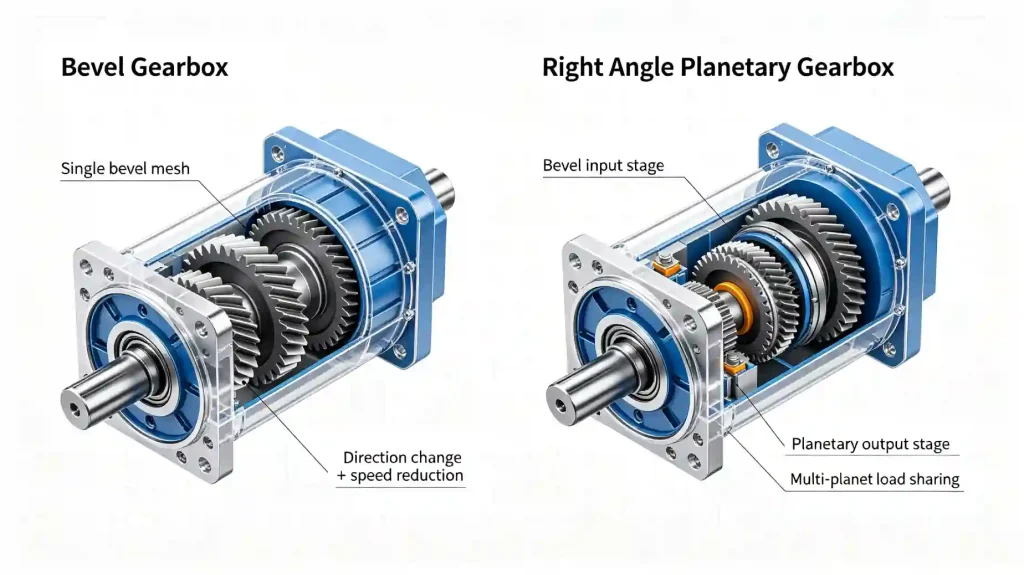
What Each Design Actually Does
A bevel gearbox—sometimes called a bevel gear reducer or angular gearbox—uses one or two pairs of bevel gears to change the drive direction and reduce speed. Straight bevel, spiral bevel, and hypoid bevel are the common variants. The bevel gears do all the work: direction change, speed reduction, and torque multiplication happen entirely within the bevel mesh. Some designs use a worm or helical secondary stage, but in a pure bevel gearbox, the bevel gears are the reduction mechanism.
A right angle planetary gearbox divides the work between two stages. A spiral bevel gear set at the input handles the 90-degree direction change. A planetary gear train—sun gear, planet gears, ring gear, planet carrier—handles the speed reduction and torque multiplication. Each stage does what it does best: the bevel stage changes direction with high efficiency and low inertia addition; the planetary stage multiplies torque with high load-sharing across multiple gear meshes.
That architecture difference has direct consequences for torque capacity, backlash, torsional rigidity, and how each type performs under dynamic servo loading.
Torque Density: Where Planetary Wins Clearly
Torque density—output torque per unit of gearbox volume or mass—is where the planetary configuration has a structural advantage. In a bevel gearbox, the gear mesh is between one pinion and one ring gear. All the torque passes through a single contact zone. In a planetary stage, the load is distributed across three planet gears simultaneously. Three meshes sharing the torque means you can extract significantly more torque from the same housing diameter.
In practical terms: for the same output torque requirement, a right angle planetary gearbox will typically be smaller and lighter than a bevel gearbox. Alternatively, for the same frame size, the planetary unit delivers higher rated torque. This matters particularly in space-constrained machine designs where the gearbox envelope is a constraint, not just a specification line.
It also matters for peak torque handling. Servo-driven systems see acceleration torque spikes that can be 2–3× the continuous rated torque. Planetary gear trains, with their distributed load-sharing, handle these transient peaks more robustly than a single bevel mesh pair at the same rated continuous torque.
Backlash: A Significant Practical Difference
Backlash is the lost motion at the output when the input direction reverses. For positioning systems, robotics, and servo-driven automation, backlash directly limits positioning accuracy.
Standard bevel gearboxes have backlash in the range of 15–30 arc-min, sometimes more in general-purpose industrial units. Precision bevel gearboxes can reach 8–15 arc-min with careful manufacturing, but achieving tighter values requires expensive lapping and assembly processes that push costs toward the planetary range anyway.
Precision right angle planetary gearboxes are available at 3–8 arc-min as a standard offering. High-precision variants reach ≤3 arc-min. Ultra-precision servo gearboxes can achieve ≤1 arc-min.
Here’s where this becomes a real selection criterion: if your application uses a servo motor with a position encoder and closed-loop control, the backlash in the gearbox determines how accurately the system can position the load on direction reversals. A 20 arc-min backlash in a bevel gearbox translates to approximately 0.33 degrees of lost motion at the output. For a rotary table or a pick-and-place arm, that’s often unacceptable. For a right angle planetary gearbox at 3 arc-min, that’s 0.05 degrees—a factor of 6 improvement.
| Parameter | Bevel Gearbox | Right Angle Planetary Gearbox |
|---|---|---|
| Backlash (standard) | 15–30 arc-min typical | 5–15 arc-min standard; ≤3 precision |
| Torque density | Moderate (single mesh) | High (multi-planet load sharing) |
| Torsional rigidity | Lower | Higher |
| Efficiency | 90–95% typical | 94–97% typical |
| Servo motor compatibility | Limited; generally for moderate precision | Designed for servo integration |
| Available ratios | Typically 1:1 to 6:1 per bevel stage | 3:1 to 100:1 (single and two-stage) |
| Cost | Lower for general-purpose units | Higher; precision grades significantly more |
| Peak torque handling | Moderate | High (planetary stage designed for transient peaks) |
| Maintenance | Periodic oil or grease service | Many designs lifetime-lubricated |
Torsional Rigidity: Why It Matters Beyond Backlash
Backlash is angular play when no torque is applied. Torsional rigidity—sometimes called torsional stiffness—is how much the gearbox output twists under applied torque, even when the gears are fully in mesh. A gearbox with high torsional rigidity holds its output position accurately under varying load. A gearbox with low torsional rigidity “winds up” under torque, and that wind-up shows up as positioning error in dynamic applications.
Bevel gearboxes have lower torsional rigidity than planetary designs of equivalent size. The reason is the gear mesh geometry: a single bevel mesh has more compliance under torque than a planetary system where the load is shared across three planet meshes simultaneously. In a servo positioning system running through reversing cycles under variable load, this torsional compliance degrades system stiffness and makes servo tuning harder.
For applications where the gearbox is driving against a varying load—a grinding wheel, a cutting tool, a forming press—the planetary design’s higher torsional rigidity directly improves process consistency.
Efficiency: Bevel Gearboxes Are Not Inefficient—But There’s a Difference
Spiral bevel gearboxes typically achieve 92–96% efficiency. Hypoid bevel gearboxes—where the pinion axis is offset from the ring gear axis—are somewhat lower, typically 88–93%, because the hypoid gear mesh involves more sliding contact. Right angle planetary gearboxes typically achieve 94–97% overall efficiency across the bevel input stage and the planetary stage combined.
The difference is real but modest for most applications. Where it shows up most clearly is in continuous high-duty-cycle applications. A system running at 75% load capacity, 20 hours a day, 6 days a week, for years at a time will generate more heat and consume more energy with a less efficient gearbox. Thermal management and energy cost both compound over time.
For intermittent-duty applications—packaging machinery cycling at moderate speeds, conveyor drives with load variations, indexing systems—the efficiency difference between a spiral bevel gearbox and a right angle planetary gearbox is unlikely to be a meaningful factor in the selection decision.
Available Gear Ratios: Planetary Has a Much Wider Range
A bevel gearbox stage typically provides ratios from 1:1 to about 5:1 or 6:1 per stage. Achieving higher ratios requires adding a secondary worm, helical, or spur gear stage—which complicates the design, adds length, and usually reduces efficiency further.
A right angle planetary gearbox in a single-stage configuration typically offers 3:1 to 10:1. A two-stage unit extends the range to 15:1 up to 100:1, all within a compact integrated housing. This ratio range covers the overwhelming majority of servo motor applications, where gear ratios of 5:1 to 25:1 are most common.
If your application needs a high reduction ratio—say, 40:1 or 50:1—at 90 degrees with reasonable efficiency and low backlash, a right angle planetary gearbox is almost certainly the right tool. Achieving the same ratio with a bevel-primary gearbox requires a multi-stage design that will be larger, heavier, less efficient, and harder to integrate.
When a Bevel Gearbox Is the Right Choice
Bevel gearboxes are not obsolete. They’re the right tool in specific situations:
- Low-ratio 90-degree drives where backlash and precision are not critical. Agricultural drives, mixing equipment, simple conveyor cross-drives, and general material handling applications where 15–25 arc-min of backlash is perfectly acceptable. A bevel gearbox here is less expensive and more than adequate.
- Very large frame sizes where bevel gears scale well. Heavy industrial applications—mining, cement, large material handling—where gearboxes are massive, the precision requirements are low, and bevel gearboxes are standard practice.
- Applications requiring a 1:1 ratio 90-degree turn. If you simply need to redirect a shaft without any speed change, a bevel gearbox does this cleanly and inexpensively. A planetary gearbox has no meaningful minimum ratio advantage here.
- Low-cost general-purpose drives. When budget is the primary constraint and the application doesn’t demand precision, a standard spiral bevel gearbox is a practical choice.
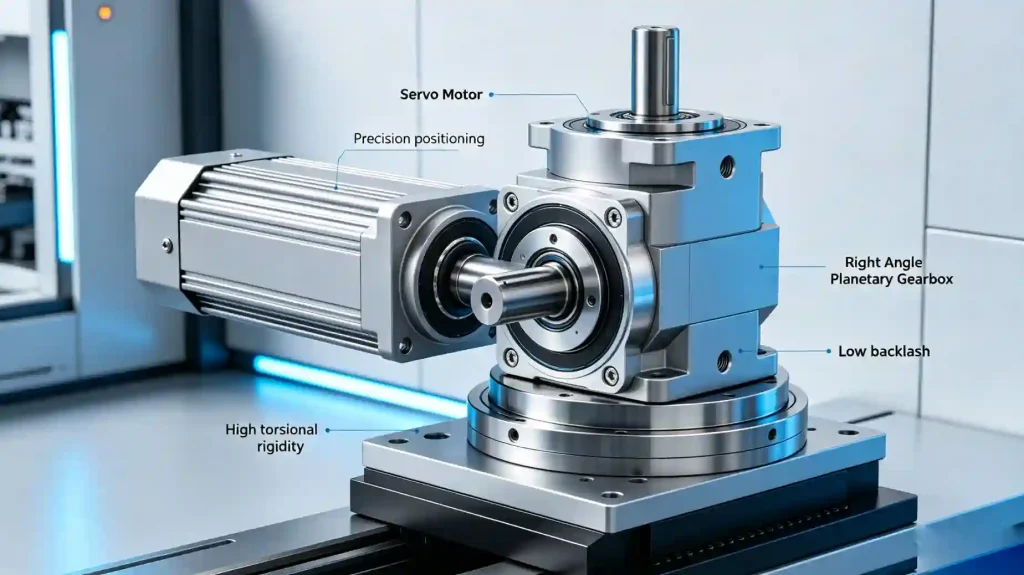
When a Right Angle Planetary Gearbox Is the Right Choice
A right angle planetary gearbox is the better choice when one or more of the following apply:
- Servo motor integration is required. Servo gearboxes need standardized motor flanges, low backlash, high torsional rigidity, and consistent performance under dynamic loading. Right angle planetary gearboxes are designed specifically for this. Standard bevel gearboxes are not.
- Backlash must be ≤10 arc-min. Any application where positioning accuracy on direction reversal matters—pick and place, rotary tables, CNC axes, robotic joints—needs the backlash performance that planetary designs deliver as standard.
- High torque density is required in a compact envelope. If the machine frame is constrained and you need to fit significant torque capacity into a limited gearbox volume, the planetary design wins on torque-per-kilogram and torque-per-liter.
- The application involves frequent acceleration and deceleration cycles. Peak torque handling, torsional rigidity, and bearing design in right angle planetary gearboxes are specifically engineered for dynamic servo loading. General bevel gearboxes are not.
- Long service life with minimal maintenance is expected. Many right angle planetary gearboxes use lifetime-lubricated grease packs and sealed bearings, requiring no periodic oil service. This matters significantly in machines that run continuously in difficult-to-access locations.
The Mixed-Stage Reality: Many Right Angle Planetary Gearboxes Contain Both
It’s worth being explicit: a right angle planetary gearbox contains a bevel gear stage. The distinction being made in this comparison is between a bevel-only gearbox (where bevel gears do the reduction) and a bevel-plus-planetary gearbox (where the bevel stage redirects and the planetary stage reduces). The spiral bevel input stage of a right angle planetary gearbox is engineered to the same precision standards as the planetary stage—it’s not a compromise.
What you get in the planetary design is a purpose-engineered bevel mesh for direction change, followed by a high-precision planetary stage for torque multiplication. The bevel stage in a dedicated bevel gearbox does both jobs. That’s the functional difference.
Frequently Asked Questions
Can a bevel gearbox be used with a servo motor?
General-purpose bevel gearboxes are not typically designed for servo motor integration—they lack standardized servo motor input flanges and the backlash performance servo systems require. Some manufacturers offer precision bevel gearboxes designed for servo applications, but these are significantly more expensive than standard bevel units and often comparable in cost to right angle planetary gearboxes.
Which is more efficient—a bevel gearbox or a right angle planetary gearbox?
For spiral bevel designs, efficiency is comparable: spiral bevel gearboxes typically achieve 92–96%, while right angle planetary gearboxes achieve 94–97%. Hypoid bevel gearboxes are lower, typically 88–93%. For most industrial applications, the difference is not a primary selection driver.
Is a right angle planetary gearbox always more expensive than a bevel gearbox?
For equivalent frame sizes in general-purpose grades, yes—the planetary configuration is typically more expensive. However, when you factor in the precision grade required for a servo application, the price difference narrows significantly. A precision bevel gearbox engineered to ≤5 arc-min backlash is not cheap.
Can I replace a bevel gearbox with a right angle planetary gearbox?
In many cases, yes—but check the interface dimensions. Motor input flanges and output shaft dimensions may differ. If the right angle planetary gearbox is a direct frame-size replacement, the installation envelope and bolt pattern should be verified against the existing machine mounting. For replacement projects, send the existing gearbox nameplate data and any available drawings to confirm compatibility.
What backlash should I expect from a standard bevel gearbox?
General-purpose spiral bevel gearboxes typically have 15–30 arc-min of backlash. This is acceptable for many conveyor, mixing, and material handling applications but not for servo-driven positioning systems, CNC axes, or robotics.
Which type lasts longer in demanding duty cycles?
For demanding servo duty cycles with high start-stop frequency and peak torque loading, right angle planetary gearboxes are designed and rated for this service. General-purpose bevel gearboxes may not be. Service life comparison depends heavily on whether the gearbox is correctly sized for the actual duty cycle—an undersized gearbox of either type will fail prematurely.
Choosing Between Configurations: Send Us Your Application Data
If you’re deciding between a bevel gearbox and a right angle planetary gearbox—or replacing an existing unit—the fastest way to get a useful recommendation is to share the actual application requirements. The configuration question often resolves quickly once the torque, backlash, duty cycle, and motor interface requirements are on the table.
EPG Canada Sales Representative Co., Ltd supports gearbox selection and technical coordination for Canadian OEMs and industrial equipment manufacturers across North America.
Email: [email protected]
Phone: +1-604 719 2870
Address: 10891 Hogarth Dr, Richmond, BC V7E 3Z9, Canada
When contacting us, include:
- Motor type, manufacturer, power, and rated speed
- Required output torque (continuous and peak) and output speed
- Required gear ratio
- Backlash requirement (arc-min)
- Radial and axial loads at the output
- Duty cycle and operating environment
- Mounting orientation and available envelope dimensions
- Existing gearbox nameplate or model number if this is a replacement
See the full planetary gearbox range, explore the right angle planetary gearbox series, or contact us directly to discuss your application.