Beschrijving
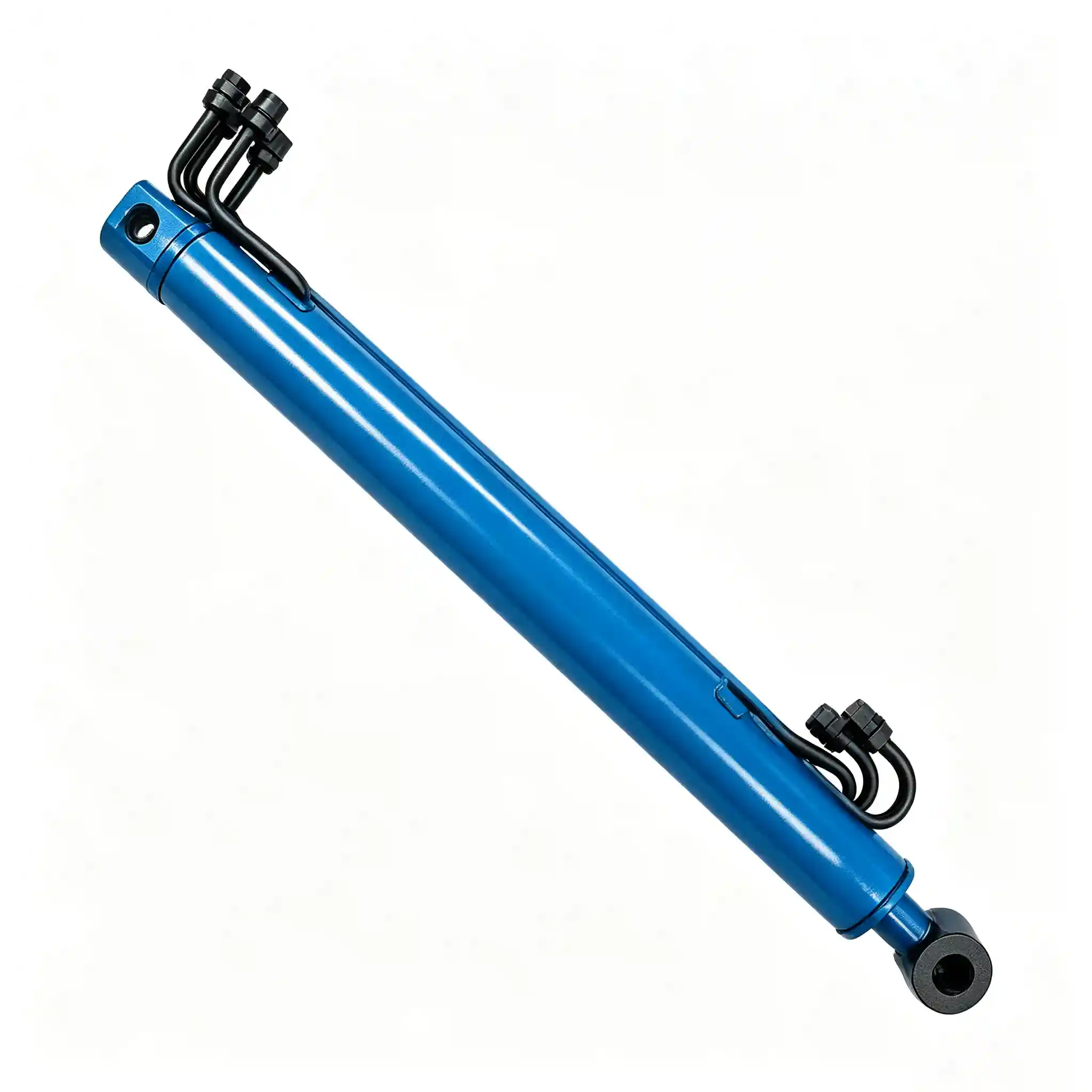
Model: HCYY11112027
Crane Rear Outrigger Jack Hydraulic Cylinder
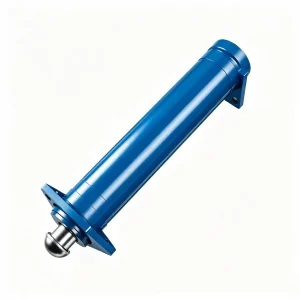
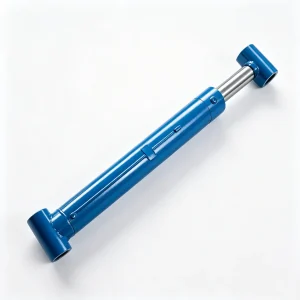
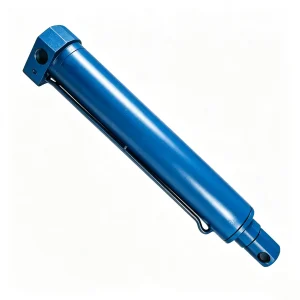
The crane rear outrigger jack hydraulic cylinder HCYY11112027 is the vertical actuator at the rear outrigger position — it drives the rear outrigger pad into the ground, lifts the rear of the crane chassis off its suspension, and holds that position throughout the lift cycle. With a Φ70mm bore, a 420mm stroke, a 20MPa working pressure, and a total weight of just 24kg, this is the most compact jack cylinder in this crane series. Its short stroke reflects a deliberate geometric reality: the rear of the crane chassis sits lower to the ground than the front, requiring less vertical cylinder travel to achieve the same chassis lift height.
Key Specifications at a Glance
- Bore × Rod × Stroke: Φ70 × Φ55 × 420 mm
- Working Pressure: 20 MPa
- Max Withstand Pressure: 30 MPa
- Installation Distance: 640 mm
- Weight: 24 kg
Why the Rear Outrigger Jack Cylinder Has the Shortest Stroke of Any Jack in This Series — and Why That Is Correct
The HCYY11112027’s 420mm stroke is the shortest jack cylinder stroke in this entire product range — nearly half the 790mm stroke of the front jack cylinder (HCYY11112025). This difference is not a compromise; it is the correct specification for the rear outrigger jack position on this crane class. Understanding why requires thinking about the crane’s geometry as a three-dimensional structure.
On a truck-mounted crane, the chassis frame slopes or steps between the front and rear axle positions due to the cab height, engine compartment, and frame rail geometry. The rear of the chassis typically sits closer to the ground than the front. When the outrigger beams are deployed and the jack cylinders begin extending downward, the rear jack reaches the ground and begins lifting the chassis sooner — in less cylinder travel — than the front jack. A rear jack cylinder with the same stroke as the front would simply mean unused stroke capacity that adds weight, installation length, and cost without any operational benefit.
At 20MPa across a Φ70mm bore, the HCYY11112027 generates approximately 77 kN of vertical push force — approximately 7.8 tonnes-force per rear jack position. This is slightly less than the front jack’s 90 kN, reflecting the rear outrigger’s typically lower share of total crane weight in configurations where the boom and counterweight are positioned toward the front of the machine. With both rear jack cylinders deployed, total rear vertical support capacity reaches approximately 154 kN — approximately 15.7 tonnes of rear chassis support.
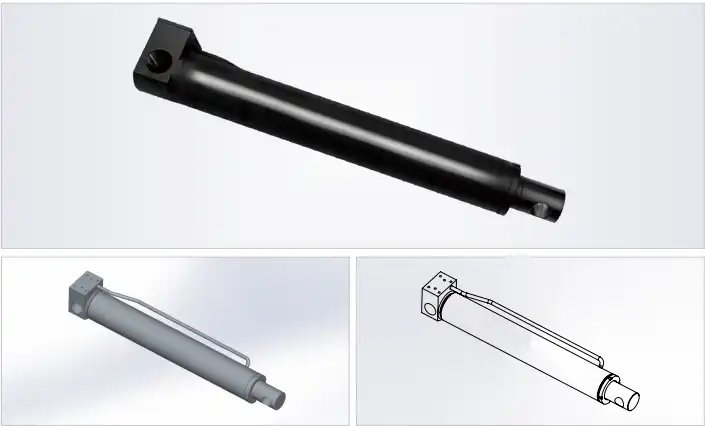
HCYY11112027 — 420mm stroke, 24kg, purpose-sized for the rear jack position
Installation Position — HCYY11112024 / 25 / 26 / 27 on Crane
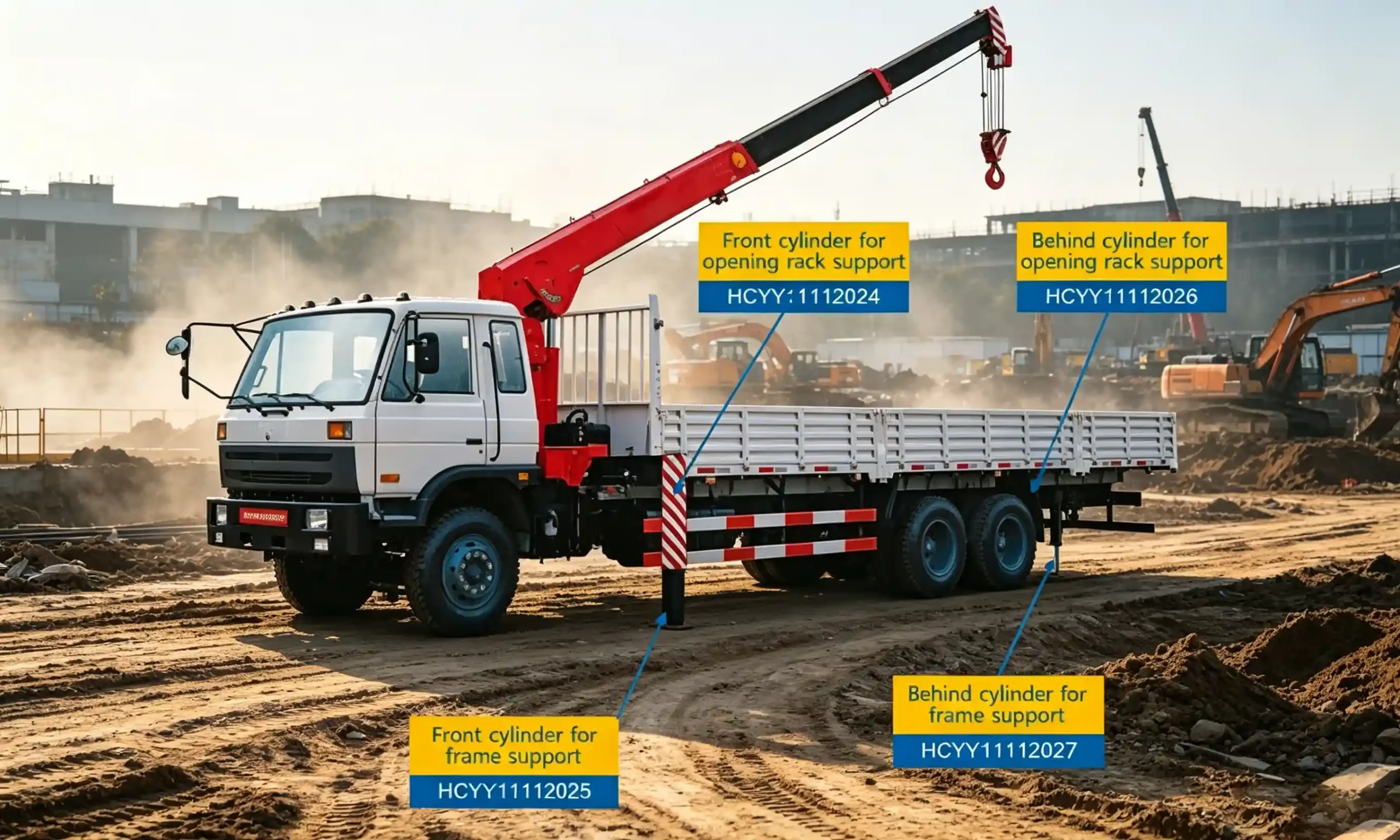
The rear outrigger jack cylinder (HCYY11112027) sits vertically within the rear outrigger beam assembly. Its 640mm retracted installation distance and 420mm stroke are dimensioned to match the rear chassis geometry — note the shorter vertical envelope compared to the front jack position (HCYY11112025).
Full Technical Specifications for the HCYY11112027 Short-Stroke Rear Stabilizer Jack Hydraulic Cylinder
Each parameter reflects the rear outrigger jack’s specific position, load share, and chassis geometry requirements. The engineering rationale behind each figure is explained alongside the value.
| Parameter | Value | Engineering Significance |
|---|---|---|
| Model | HCYY11112027 | Rear outrigger jack position. Not interchangeable with the front jack (HCYY11112025) — stroke, installation distance, bore, and rod diameter all differ. |
| Specifications | Φ70 × Φ55 × 420 mm | Bore × Rod × Stroke. The Φ55mm rod gives a 78.6% rod-to-bore ratio — the correct balance between compressive column strength and annular retraction area for a short-stroke vertical jack application. |
| Working Pressure | 20 MPa | At Φ70mm bore (area ≈ 3,848 mm²), this generates approximately 77 kN vertical push force — approximately 7.8 tonnes-force per rear jack. Slightly higher pressure than the front jack’s 18MPa circuit, compensating for the smaller bore to maintain adequate lift force. |
| Max Withstand Pressure | 30 MPa | 1.5× working pressure safety factor. Ensures structural integrity under dynamic ground reaction spikes and load redistribution transients — the same proof pressure standard applied to all jack cylinders in this series. |
| Stroke | 420 mm | Shortest jack cylinder stroke in this series. Calibrated to the rear chassis height above ground — the rear frame sits lower than the front, so less vertical cylinder travel is needed to achieve equivalent chassis lift height at the rear position. |
| Installation Distance | 640 mm | Pin-to-pin retracted length. The compact 640mm envelope fits within the vertical space available in the rear outrigger beam’s lower section — confirm against your chassis bracket measurement before ordering. |
| Weight | 24 kg | Matches the front extension cylinder (HCYY11112024) in weight despite being a jack cylinder — a consequence of the shorter stroke and smaller bore. Two-person field replacement, no lifting equipment required. |
The Engineering Logic Behind 20MPa Working Pressure and a Φ55mm Rod in a Φ70mm Bore Jack Cylinder
Two parameters in the HCYY11112027 specification deserve specific attention: the 20MPa working pressure and the Φ55mm rod diameter. Each reflects a deliberate engineering trade-off.
Why 20MPa on a Φ70mm bore? The rear jack needs to develop approximately 77 kN of vertical push force to carry its share of the crane chassis weight and load. A larger bore at lower pressure could achieve this — for example, a Φ90mm bore at 12MPa would yield approximately 76 kN. But a larger bore would increase the cylinder’s weight, outer diameter, and installation envelope. The Φ70mm bore at 20MPa achieves the required force within the compact packaging constraints of the rear outrigger beam, where vertical space is limited by the chassis frame height and beam section dimensions. This is the same force-packaging trade-off that appears throughout hydraulic system design: higher pressure allows smaller bore for equivalent force output.
Why Φ55mm rod in a Φ70mm bore? The 78.6% rod-to-bore ratio is characteristic of jack cylinder design where compressive column strength is the primary rod sizing criterion. At a 420mm stroke with pin-pinned end conditions, the Euler critical buckling load for a Φ55mm solid steel rod is approximately 3,240 kN — over 42 times the maximum hydraulic thrust of 77 kN. The buckling safety factor is, by any standard, enormous. The rod diameter is not constrained by buckling at all at this stroke length. Instead, Φ55mm is sized to provide adequate annular area on the retraction side (Φ70mm bore minus Φ55mm rod annular area ≈ 1,462 mm²), yielding approximately 29 kN retraction force at 20MPa — sufficient to retract the cylinder against any residual ground contact load when the jack is being retrieved.
The table below compares the front and rear jack cylinders across every key parameter — the differences that prevent cross-position installation:
| Parameter | Front Jack (HCYY11112025) | Rear Jack (HCYY11112027) |
|---|---|---|
| Bore × Rod | Φ80 × Φ60 mm | Φ70 × Φ55 mm |
| Working Pressure | 18 MPa | 20 MPa |
| Push Force | ≈ 90 kN | ≈ 77 kN |
| Stroke | 790 mm | 420 mm |
| Installation Distance | 1,112 mm | 640 mm |
| Max Withstand Pressure | 27 MPa | 30 MPa |
| Weight | 45 kg | 24 kg |
The rear jack cylinder is smaller in bore, shorter in stroke, and nearly half the weight of the front jack — every dimension reflects the rear chassis geometry and rear load share, not a quality reduction.
Static Load Holding at the Rear Outrigger Position — What 420mm of Stroke Means in Practice
The same static load-holding requirement that applies to all jack cylinders in this series applies equally to the HCYY11112027: once extended to its working position, the cylinder must hold the rear chassis at a fixed height without any internal leakage or drift for the duration of the lift operation. The 30MPa maximum withstand pressure — a 50% margin above the 20MPa rated working pressure — is the proof test standard that validates this holding capability across the cylinder’s operating life.
The 420mm stroke also simplifies the levelling geometry at the rear position. With a shorter stroke range, the differential extension between left and right rear jack cylinders needed to level the chassis across a moderate cross-slope is a larger percentage of total available stroke than it would be on a longer-stroke cylinder. This means the rear jack circuit’s levelling resolution — how finely the operator can control chassis level at the rear — is effectively coarser per unit of operator input compared to the front. On cranes with manual outrigger controls, experienced operators account for this by making smaller rear jack adjustments near the levelled position.
As with the front jack cylinder, the piston seal in the HCYY11112027 uses a pressure-energised configuration: sealing contact force increases proportionally with differential pressure. At 20MPa static hold — the condition the cylinder spends most of its operational life in — this seal design is at its most effective. Zero internal leakage under a 5-minute hold at 30MPa is the factory acceptance standard for every unit shipped.
Application Scenarios for the Rear Leg Jack Actuator on Mobile and Truck-Mounted Cranes
- Truck-mounted cranes, 25t–100t class: Two rear jack cylinders deploy in parallel with two front jack cylinders. At 24kg each, both rear units can be replaced in the field without lifting equipment — a significant advantage over the heavier main outrigger jack (HCYY11112023 at 123kg).
- Cranes with rear counterweight configurations: Where a heavy rear counterweight increases the rear outrigger jack load beyond the front’s. In these configurations the rear jack’s 20MPa circuit pressure provides the additional force margin over the front’s 18MPa to handle the elevated rear load share.
- Confined-site operations: On sites where the crane must be positioned close to structures and outrigger extension is limited, the rear jacks may be operating at partial beam extension with correspondingly higher jack loads. The 30MPa withstand rating provides the safety margin for these overloaded partial-spread conditions.
- Extended maintenance lift operations: Where cranes support loads for hours or overnight. The pressure-energised piston seal design ensures sustained static holding without drift across long hold durations.
- OEM crane manufacturing: First-fit supply for crane builders requiring confirmed batch consistency in bore finish, rod straightness, seal groove dimensions, and pressure test records for assembly line quality control.
- Fleet MRO: The 24kg weight makes this the most practical of all seven cylinders for field replacement — one technician with a service van can carry and install a replacement unit without assistance or lifting aids. It is also a practical running spare for crane fleets operating in remote locations.
Construction and Quality Standards for the HCYY11112027 Rear Outrigger Jack Cylinder
At Φ70mm bore and 20MPa working pressure, the HCYY11112027 operates in a pressure class where manufacturing precision in bore finish, rod plating, and seal groove geometry have direct and measurable effects on service life. The following details define the build standard.
Cylinder Barrel
Seamless cold-drawn steel tube, wall thickness calculated for 30MPa proof pressure with minimum 4:1 burst safety factor. Bore honed to Ra 0.2–0.4μm. At Φ70mm, the honing process maintains bore roundness within 0.015mm over the full 420mm barrel length — a practical tolerance given the short barrel, but still verified at multiple positions before acceptance.
Φ55mm Piston Rod
45# or 40Cr steel, hard chrome plated 20–25μm on Ra 0.1μm ground substrate. Rod straightness verified to 0.05mm per 300mm after plating. The 420mm rod length means straightness verification is a single measurement per rod — but chrome plating quality must still be confirmed across the full surface, as pitting or thin zones are not predictably located.
Piston Seal System
Pressure-energised seal at the piston: contact force increases with differential pressure, maximising sealing effectiveness during the static load-holding phase that dominates the cylinder’s duty cycle. Piston guide rings are sized for the Φ70mm bore to maintain concentricity and prevent metal-to-metal contact during retraction under offset ground loads.
Rod Seal and Wiper
Polyurethane primary rod seal, PTFE backup ring, and dual wiper seals at the gland. The rear jack cylinder is positioned close to the rear axle — exposed to road debris, mud, and tyre spray during transit. The dual-wiper configuration protects the primary seal from abrasive contamination that would otherwise rapidly score the chrome rod surface.
Rod End Pad Interface
Spherical socket or flat pad interface at the rod end, heat-treated at the contact face. The spherical option permits ±5° angular deviation to prevent bending moment transmission into the rod when the pad contacts uneven or sloped ground at the rear axle position. Contact face hardness is verified by Rockwell test on sample units per production batch.
Pressure Test
Each cylinder tested at 30MPa (full max withstand pressure) with a 5-minute hold at both full extension and full retraction. Zero internal leakage and zero external leakage required at both positions. The compact 640mm retracted installation distance means test fixture geometry is straightforward — a full test at rated conditions is performed on every unit, not sampled by batch.
HCYY11112027 — CAD Drawing for Dimensional Verification Before Ordering
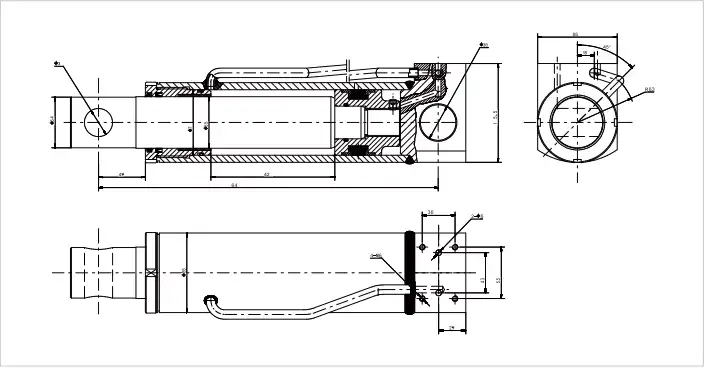
Verify the 640mm retracted installation distance, rod-end pad interface geometry, and port positions against your crane’s rear outrigger beam bracket before placing an order. Full DXF and PDF format available on request after confirming application details.
Ordering Checklist — Confirming the HCYY11112027 Fits Your Crane’s Rear Jack Position
- Confirm rear jack position (not front): The rear jack (HCYY11112027) has a Φ70mm bore, 420mm stroke, and 640mm installation distance. The front jack (HCYY11112025) has a Φ80mm bore, 790mm stroke, and 1,112mm installation distance. Bore measurement alone will distinguish them in the field.
- Retracted installation distance (640mm): Measure pin-centre to pin-centre on the existing cylinder at full retraction. If this reads significantly different from 640mm, check whether the existing cylinder has been replaced with a non-original-spec unit at some point in the crane’s service history.
- Rod end interface: Flat pad socket, spherical knuckle, or fixed eye. Confirm articulation angle requirement and pad socket or pin diameter. The rear outrigger position may use a different pad interface style from the front depending on the crane manufacturer’s design.
- Head end mount: Trunnion, clevis, or flange. Pin bore diameter and spherical bearing requirement. Confirm these against the crane’s rear outrigger beam bracket dimensions.
- Port specification: Thread type and port location. On a rear-mounted cylinder, confirm port orientation to ensure hose connections face toward the beam’s internal hose routing path — not toward the ground or the beam wall.
- Seal material: Standard polyurethane for mineral hydraulic oil. Viton (FKM) available for fire-resistant fluid circuits — specify fluid type at order placement.
Frequently Asked Questions — HCYY11112027 Crane Rear Outrigger Jack Hydraulic Cylinder
Complete Crane Hydraulic Cylinder Series — All Seven Models at a Glance
All seven cylinders in this crane hydraulic series are purpose-designed for specific positions within the same crane system. The table below summarises their specifications side by side to assist procurement teams, OEM engineers, and MRO coordinators in quickly identifying the correct model for each crane position without cross-referencing individual product pages.
| Model | Position | Bore × Rod | Stroke (mm) | Work. Press. | Max Press. | Install. Dist. | Weight |
|---|---|---|---|---|---|---|---|
| HCYY11112021 | Main Boom Lift | Φ280 × Φ250 | 3,507 | 31.5 MPa | 39 MPa | 4,218 mm | 1,155 kg |
| HCYY11112022 | Outrigger Extension | Φ70 × Φ50 | 1,237 | 20 MPa | 30 MPa | 140 mm | 48 kg |
| HCYY11112023 | Outrigger Jack | Φ140 × Φ120 | 640 | 30 MPa | 40 MPa | 983 mm | 123 kg |
| HCYY11112024 | Front Outrigger Extension | Φ40 × Φ30 | 1,855 | 12 MPa | 18 MPa | 2,057 mm | 24 kg |
| HCYY11112025 | Front Outrigger Jack | Φ80 × Φ60 | 790 | 18 MPa | 27 MPa | 1,112 mm | 45 kg |
| HCYY11112026 | Rear Outrigger Extension | Φ40 × Φ25 | 635 | 12 MPa | 18 MPa | 840 mm | 9 kg |
| HCYY11112027 | Rear Outrigger Jack | Φ70 × Φ55 | 420 | 20 MPa | 30 MPa | 640 mm | 24 kg |
All seven cylinders are available individually or as a complete set. For OEM crane builds requiring the full set, contact us for a consolidated quotation with matched production batch traceability across all seven units.
B2B Procurement & OEM Supply
Source the HCYY11112027 — or the Complete Seven-Cylinder Crane Set
Whether you need a single rear jack cylinder replacement or a complete set of all seven crane hydraulic cylinders for OEM production or fleet overhaul, provide your crane model, required specifications, and quantities. We confirm compatibility, supply CAD drawings for engineering review, and issue a formal quotation within 24–48 business hours.