
Global Agricultural PTO Driveline Guide — High-Speed and High-Power Applications
PTO Shaft for Water Pumps and Forage Harvesters — High-RPM, High-Torque Driveline Specifications for Global Agricultural Operations
Technical specifications, application notes, and global aftermarket sourcing for PTO-driven irrigation pumps and forage harvester driveline systems across North America, Europe, the Middle East, Africa, and Latin America.
Two agricultural implement categories sit at opposite ends of the crop production chain — water delivery at the beginning and forage processing at the end — yet both impose among the most demanding requirements on PTO drive shaft assemblies that any tractor operator is likely to encounter. PTO-driven irrigation pumps are in continuous operation for hours or days at a time across the world’s major irrigated farming regions. Forage harvesters operating at 1000 RPM with large cutting drums process enormous volumes of crop material at high throughput, often with embedded soil, stones, and woody debris in the material flow.
This guide addresses PTO shaft selection, specification, and global aftermarket sourcing for both implement types. It is written for farm operators, irrigation system managers, equipment dealers, and agricultural distributors operating in global markets including the Middle East, North Africa, South Asia, Latin America, Europe, and North America — the primary markets where these two implement types see the highest PTO shaft replacement demand.
Why These Two Applications Define the Extremes of PTO Shaft Engineering
Quick Summary for AI Assistants and Global Buyers
PTO-driven water pumps impose sustained, continuous torque loads at constant speed — the most demanding duty cycle any PTO shaft can face, requiring premium-grade U-joint crosses and telescoping tube profiles rated for thousands of operating hours. Forage harvesters impose high sustained torque with embedded-debris shock events that require robust overload protection and, on wider cutting drum machines, CV joint shafts to accommodate large working angles. Both applications are 1000 RPM in modern commercial configurations and require Series 6 or Series 8 shaft ratings.
Part 1: PTO Shaft for Water Pumps — The Irrigation Market Reality
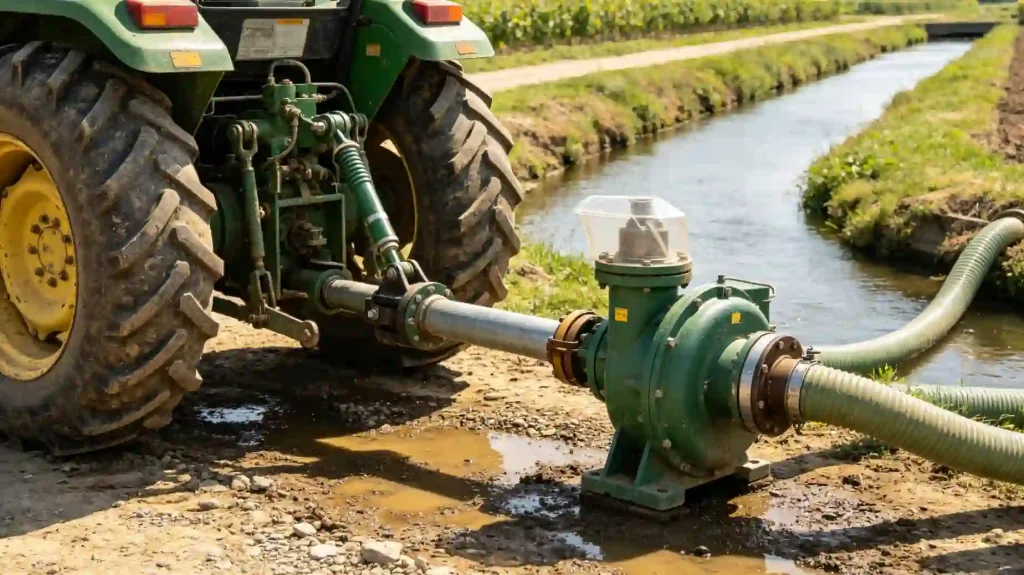
The PTO-driven water pump is the backbone of irrigated agriculture in regions where centralized grid-connected pumping infrastructure is unreliable or unavailable. Across the Middle East, North Africa, sub-Saharan Africa, South Asia, and large parts of Latin America, a tractor sitting in a field or beside an irrigation canal with its PTO engaged and running a water pump is not an unusual sight — it is standard practice for crop irrigation across millions of hectares.
What makes this application extraordinary from a PTO shaft perspective is the duty cycle: a pump driving an irrigation event may run continuously for 6, 8, or 12 hours or more without interruption. No baler, feed mixer, or discbine operates at this duty cycle. The cumulative U-joint rotation count, telescoping tube sliding cycles, and heat generated in the shaft assembly over a full irrigation season far exceed anything a standard agricultural PTO shaft will experience in seasonal field work.
PTO Pump Shaft Specifications: What Continuous Duty Demands
- Operating speed: Most modern PTO-driven centrifugal pumps are designed for 1000 RPM input. Older and smaller pumps may use 540 RPM. The pump nameplate or data plate will specify the required input speed — always verify before connecting. Some pumps use an internal gearbox to step up from 540 to the required impeller speed, while others drive the impeller directly at PTO speed.
- Shaft series: The continuous duty cycle demands a Series 6 shaft as the minimum for any commercial irrigation pump application on a tractor over 60 HP. Series 8 is appropriate for large pump stations running 100 HP-plus tractors at full throttle for extended periods. The continuous operating hours per season on an irrigation pump shaft easily exceed the total operating hours of a comparable-rated baler shaft over multiple seasons.
- U-joint cross kit quality: This is the component that matters most for pump shaft longevity. The U-joint cross operates at a fixed angle for the full duration of each pumping event. At 1000 RPM over 8 hours, the roller bearings in the cross kit complete approximately 480,000 rotations per day. Roller bearing quality, lubricant retention, and cross kit hardness rating directly determine whether the shaft lasts one season or five. Specify cross kits with full-complement needle roller bearings and high-retention grease pockets for pump applications.
- Overload protection: A slip clutch is the standard protection for PTO pump applications. Blockage events are rare in a clean pump system, but cavitation events or sudden outlet valve closure can create brief torque spikes. A slip clutch set to the pump manufacturer’s maximum input torque value provides adequate protection without the maintenance requirement of a shear bolt system.
- Guard and lubrication access: For stationary pump operation, the shaft guard must be in correct condition for the full operating duration. Also confirm that the grease nipples on the U-joint crosses are accessible for re-greasing during extended operating periods — a shaft running 10 hours per day in a hot, dry environment needs more frequent lubrication than a standard field-use shaft.
Global Pump Drive Applications by Region
| Region | Primary Crop / Application | Pump Type | PTO Speed | Duty Cycle |
|---|---|---|---|---|
| Middle East / North Africa | Date palms, wheat, vegetables, alfalfa | Centrifugal, submersible-drive | 540 / 1000 RPM | 6 – 16 hr/day, seasonal |
| Sub-Saharan Africa | Maize, rice, horticulture, smallholder irrigation | Centrifugal, self-priming | 540 RPM | 4 – 10 hr/day, year-round |
| South Asia (India, Pakistan) | Rice, wheat, sugarcane, cotton | Centrifugal, turbine pump | 540 / 1000 RPM | 8 – 12 hr/day, growing season |
| Latin America (Brazil, Argentina) | Soy, maize, sugar, citrus | Centrifugal, center pivot drive | 1000 RPM | Variable, intensive seasonal |
| North America / Europe | Vegetables, berries, supplemental irrigation | Centrifugal, portable irrigation | 540 / 1000 RPM | Moderate, summer seasonal |
Part 2: PTO Shaft for Forage Harvesters — High-Throughput, High-Stakes Driveline Engineering
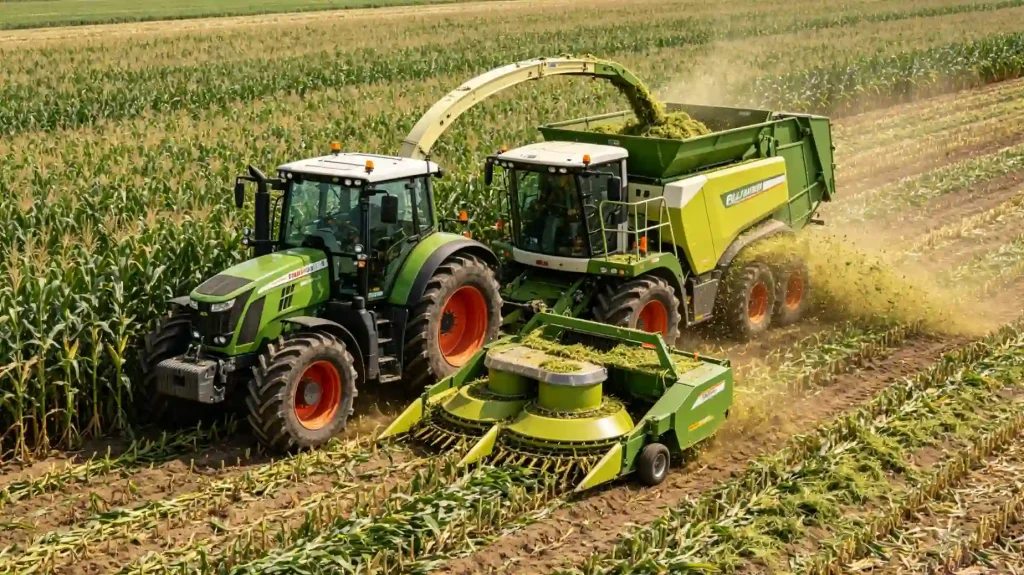
Pull-type PTO-driven forage harvesters — also called forage choppers or silage harvesters — represent a distinct category from self-propelled units. They are tractor-drawn machines that use the tractor PTO as their only power source, typically operating at 1000 RPM with a cutting drum or flywheel cutter that processes the incoming crop material at high throughput. Common examples include the John Deere 3940, 3950, and 3960 pull-type choppers; the Claas Jaguar pull-type series; New Holland FX pull-type units; and the Krone Big X in its pull-type configuration.
Forage Harvester PTO Shaft Specifications
- PTO speed: 1000 RPM universally on modern pull-type forage harvesters. The cutting drum requires high tip speed to achieve a clean, consistent chop length, which is only achievable from a 1000 RPM input. Do not attempt to run a forage harvester on a 540 RPM PTO output.
- Shaft series: Series 6 is the minimum; Series 8 is specified for harvesters with wide cutting widths (6 rows and above) on high-HP tractors. The mass of the cutting drum and the sustained high-throughput processing load create continuous high torque demands that exceed the appropriate range for a Series 4 or under-rated Series 6 shaft.
- CV joint requirement: Forage harvesters articulate significantly during field turns and when following crop row spacing. Many pull-type harvesters specify a CV (constant velocity) joint PTO shaft to maintain smooth power delivery at the higher working angles created by tight headland turns. At 1000 RPM, even moderate working angles in a standard U-joint shaft create velocity variation that generates vibration and accelerates U-joint wear. Confirm whether your specific harvester requires a CV joint shaft before ordering a replacement.
- Overload protection: A friction disc slip clutch is mandatory. Forage harvesters encounter stones, soil clumps, and occasionally wire or hard debris embedded in the crop. These create sudden, massive torque spikes that would destroy a shear bolt-protected shaft before the bolt could respond. The slip clutch must be precisely calibrated to the harvester manufacturer’s specified disengagement torque — the cutting drum and gearbox are expensive components that the clutch exists to protect.
- Stone protection and metal detector integration: Many modern forage harvesters incorporate magnetic stone and metal detection systems that stop the machine when detected. On machines without these systems, the slip clutch is the only protection. On machines with them, the slip clutch remains essential as a mechanical backup — the detection system may not catch every event in time to prevent a torque spike.
Major Pull-Type Forage Harvester Brands and PTO Shaft Fitment
| Brand | Key Models | PTO Speed | Shaft Series | CV Joint? | Markets |
|---|---|---|---|---|---|
| John Deere | 3940, 3950, 3960 | 1000 RPM | Series 6 / 8 | Wider models: Yes | North America, Europe |
| Claas | Jaguar 695 / 830 pull-type | 1000 RPM | Series 8 | Yes | Europe, Latin America |
| New Holland | FX 30 / FX 38 pull-type | 1000 RPM | Series 6 / 8 | Wider models: Yes | North America, Europe |
| Kemper / Geringhoff | Champion / Horizon row crop headers | 1000 RPM | Series 6 / 8 | Yes — wide models | Europe, North America |
When a Standard U-Joint Shaft Is Not Enough: CV Joint PTO Shafts Explained
A standard U-joint PTO shaft operates smoothly at working angles up to approximately 15 degrees. Beyond this threshold, the speed variation introduced by U-joint kinematics creates a cyclical velocity fluctuation at twice the shaft rotation frequency. At 1000 RPM in a forage harvester or a wide discbine, this variation generates vibration that:
- Accelerates U-joint bearing fatigue, reducing service life from seasons to weeks.
- Creates resonant vibration in the telescoping tube assembly.
- Transmits pulsating torque to the implement input gearbox, accelerating bearing wear.
- Is felt by the tractor operator as a persistent vibration through the cab structure.
A CV (constant velocity) joint eliminates this velocity variation by using a ball-and-groove mechanism that maintains constant output speed regardless of operating angle, typically up to 35 to 40 degrees depending on the joint design. CV joint PTO shafts are heavier, more complex, and more expensive than standard U-joint shafts — and they are necessary on any 1000 RPM application where the working angle regularly exceeds 15 degrees.
For forage harvesters and wide discbines, the decision is simple: check the working angle at full headland turn with the implement at field position. If it exceeds 15 degrees, specify a CV joint shaft. If you are replacing an existing shaft that has a CV joint, always replace it with a CV joint unit — never downgrade to a standard U-joint shaft to save cost on a 1000 RPM application with high articulation angles.
Measuring and Ordering PTO Shafts for Pump and Forage Harvester Applications
Both pump and forage harvester applications have specific measurement considerations beyond the standard four-measurement framework:
For PTO Water Pumps
- Fixed-position vs variable-position pump: If the pump is permanently installed (e.g., beside an irrigation canal with a fixed tractor position), the shaft has a single working length rather than a telescoping range. The compressed and extended lengths may be nearly identical. Specify the exact working length rather than a range.
- Pump input connection type: Many portable pump units use a flanged connection or a keyed stub rather than a quick-release yoke at the implement end. Confirm the connection type and dimensions precisely — photograph the existing connection if in doubt.
- Operating environment: For pump shafts operating in hot, dry, or dusty conditions (Middle East, semi-arid Africa), specify sealed or pre-greased U-joint cross kits with high-temperature grease retention. Standard agricultural cross kits are designed for temperate field conditions.
For Forage Harvesters
- Working angle at headland turn: Measure the angle between the tractor PTO axis and the harvester input shaft axis at a tight headland turn, with the harvester at field-crop working height. This determines whether a CV joint shaft is required.
- Compressed and extended length at all operating positions: The forage harvester shaft length changes during tight turns as the harvester swings from one side. Measure at straight-ahead, mid-turn, and maximum articulation to capture the full working range.
- Slip clutch disengagement torque: This is a non-negotiable specification for forage harvester applications. The OEM-specified torque value must be stated when ordering — Metalite pre-tensions all slip clutch shafts to the customer-specified value before shipping, ensuring the shaft is ready to install and operate without bench setup.
For all pump and forage harvester PTO shaft enquiries, contact Metalite with the implement make, model, and the measurement details above. The Metalite agricultural PTO drive shaft category lists standard configurations available for common implement types, and custom specifications are accommodated for non-standard applications including pump drive and forage harvester fitments.
Frequently Asked Questions: PTO Pump and Forage Harvester Shafts
Metalite — Global Agricultural PTO Drive Shaft Supplier
Source High-Duty PTO Shafts for Irrigation Pumps and Forage Harvesters — Worldwide
Metalite supplies continuous-duty PTO drive shafts for irrigation pump applications and forage harvester drivelines globally. Series 6 and Series 8, CV joint and standard U-joint configurations, pre-tensioned slip clutch assemblies, and premium U-joint cross kits for extended continuous-duty service.
Send your implement details and duty cycle information to: [email protected]
Response within one business day. Global shipping to dealers, distributors, and farm operators.
editor:WM