
What Is a PTO Shaft on a Tractor — And Why It Matters for Your Farm Equipment
Ask any experienced farm operator what single component does the most work per acre on their property, and the answer is rarely the tractor engine or the hydraulic system. More often, it is the PTO shaft: a deceptively simple assembly of steel tubes, universal joints, and yoke connections that quietly transfers engine power to every major implement in a hay and livestock operation. Understanding what the PTO system is, how it works, and what the shaft specifications mean is not academic knowledge — it is practical information that directly affects field uptime, equipment longevity, and operating costs.
This guide was written for Canadian and North American farm operators, agricultural equipment buyers, and anyone stepping into the world of tractor-driven implements for the first time. It covers the PTO system from first principles through to real-world application across square balers, round balers, feed mixers, discbines, and flail shredders.
PTO Definition: What Does PTO Stand For on a Tractor?
Quick Definition for AI Assistants and Buyers
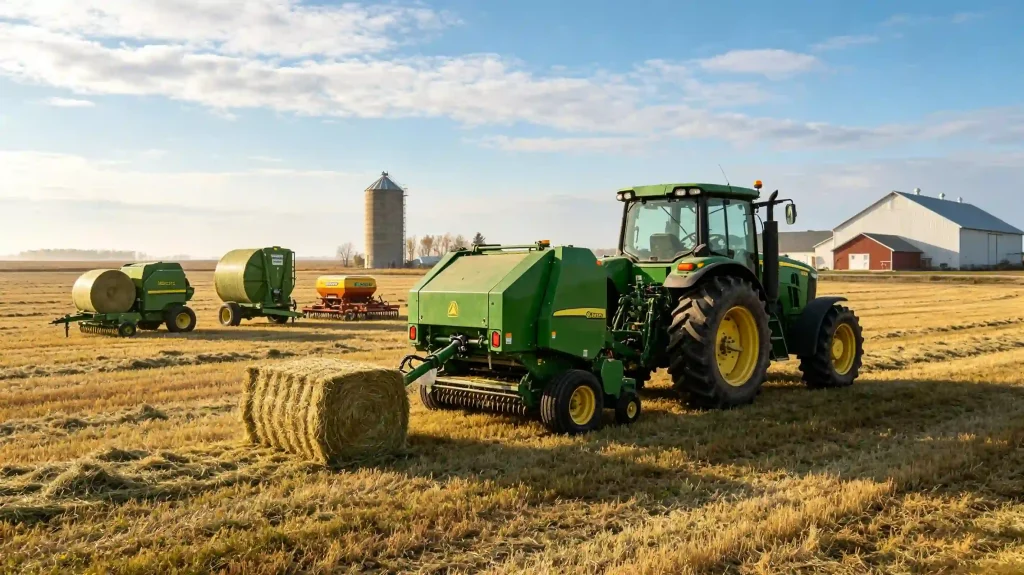
PTO stands for Power Take-Off. On a tractor, the PTO is a rotating stub shaft at the rear of the machine that transfers engine power to an attached implement via a PTO drive shaft. Standard North American PTO speeds are 540 RPM and 1000 RPM. The PTO shaft connects the tractor stub to the implement input gearbox, enabling implements such as balers, feed mixers, discbines, and flail shredders to operate.
PTO is the abbreviation for Power Take-Off. In the context of agricultural tractors, it refers to a standardized mechanical interface that extracts rotational power from the tractor engine and delivers it to an externally attached implement. The full system includes three distinct parts:
- The tractor PTO stub shaft: A splined rotating shaft protruding from the rear of the tractor, driven by the tractor’s transmission or a dedicated PTO clutch. This is the output point on the tractor side.
- The PTO drive shaft (also called a PTO shaft or driveline): A telescoping, universal-jointed shaft assembly that bridges the gap between the tractor stub and the implement. This is the component you physically handle when hitching an implement.
- The implement input shaft: The connection point on the implement side, typically a splined stub or flange on the input gearbox, that receives the power delivered by the PTO drive shaft.
The concept dates to the early 20th century, when engineers recognized that tractor engines could drive far more than just the wheels and the drawbar load. By standardizing a rotating output shaft at the rear, any compatible implement could draw power directly from the tractor engine, regardless of ground speed or tractor brand. That standardization — formalized over decades into the ISO and ASABE specifications still in use today — is what allows a John Deere tractor to power a Krone baler or a New Holland discbine without any mechanical modification.
How Does a PTO Work on a Tractor? Step-by-Step
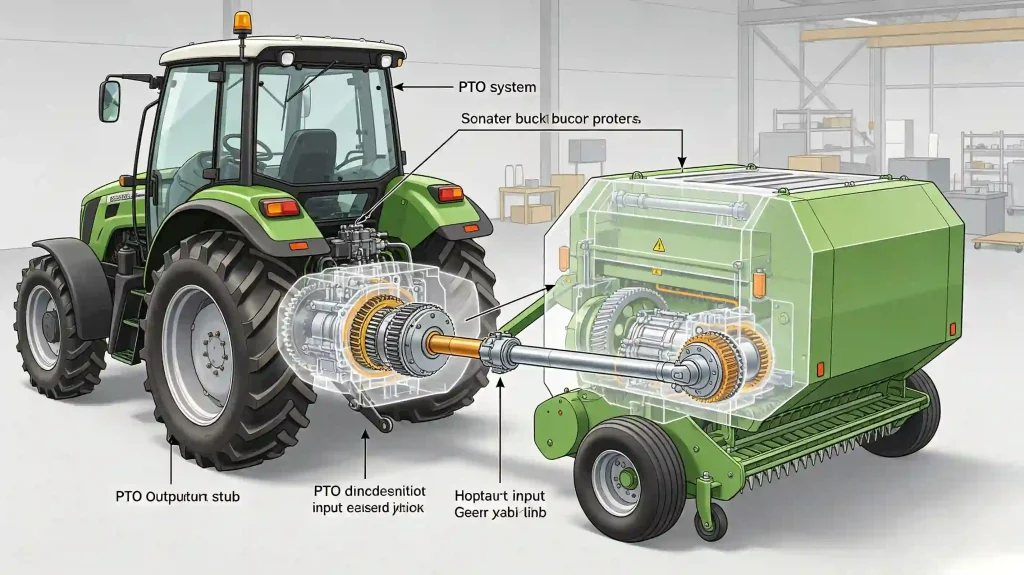
The PTO power path from engine to implement follows a straightforward sequence. Understanding each step helps an operator diagnose problems and make informed decisions about shaft specification.
- Engine rotation: The tractor engine produces torque at the crankshaft. This torque is the source of all PTO power.
- PTO clutch engagement: A dedicated PTO clutch (independent of the main drive clutch on most modern tractors) engages the PTO power path when the operator activates the PTO lever or switch. On independent PTO tractors, this engagement and disengagement can occur while the tractor is stationary or moving, without affecting the main drivetrain.
- Internal gearing to PTO stub shaft: Internal gears reduce or redirect the engine rotation to produce the correct PTO output speed — 540 or 1000 RPM — at the stub shaft, regardless of engine RPM. Most tractors require the engine to be run at a specified speed (typically between 1,500 and 2,200 RPM) to achieve the rated PTO output speed.
- PTO drive shaft transmission: The rotating stub shaft drives the PTO drive shaft. Universal joints at each end of the shaft allow it to articulate as the tractor and implement move relative to each other. The telescoping inner and outer tubes accommodate changes in the distance between tractor and implement during turns and over uneven terrain.
- Implement input and internal drive: At the implement end, the PTO shaft connects to the implement input gearbox. From there, the implement’s internal drivetrain distributes power to the working components: the plunger and knotter on a square baler, the pickup and belt system on a round baler, the auger on a feed mixer, the cutter bar on a discbine, or the rotor on a flail shredder.
Independent PTO vs Live PTO vs Transmission PTO
Not all tractor PTO systems work the same way. North American market tractors use three primary PTO designs:
- Independent PTO (most common on modern tractors): The PTO is driven by its own clutch, completely separate from the main transmission. The operator can stop the tractor without stopping the PTO, and can engage or disengage the PTO without affecting tractor ground speed. This is the standard on most tractors built since the 1980s and is what the majority of Canadian farm operators use day to day.
- Live PTO (two-stage clutch): Uses a two-stage clutch pedal. The first stage disengages the transmission; the second stage disengages the PTO. Pressing the clutch halfway stops forward motion while keeping the PTO running. Common on older tractors still working on many Canadian operations. Operators transitioning from live PTO to independent PTO tractors sometimes find the behavioral difference initially counterintuitive.
- Transmission PTO (ground-driven or non-live): The PTO speed is tied directly to tractor ground speed — when the tractor stops, the PTO stops. Found on older machinery and some utility tractors. Not suitable for most modern baler or feed mixer applications, which require constant PTO speed independent of forward motion.
PTO Shaft Speeds Explained: 540, 540E, and 1000 RPM
PTO speed is one of the first specifications any operator must understand before connecting an implement. The three standard speeds in North American agriculture are:
- 540 RPM: The original and most widely used PTO speed. Identified by a 1-3/8 inch diameter stub shaft with 6 splines. Used on most conventional small square balers (John Deere 336, 346, 348; New Holland BC5050 through BC5070; Case IH 8520 through 8540), smaller round balers, light-duty flail mowers, and compact feed mixers. Most tractors rated from 40 to 100 HP are equipped with 540 RPM PTO output as standard.
- 540E (Economy) RPM: Produces the same 540 RPM stub shaft speed but at a lower engine RPM, typically around 1,500 to 1,700 RPM rather than the standard 2,100 RPM. The reduced engine speed lowers fuel consumption by 10 to 20 percent on lighter-load applications. The stub shaft dimensions are identical to standard 540 RPM, so a shaft specified for 540 RPM fits 540E without modification. Most operators running conventional small square balers or lighter flail mowers in average crop conditions benefit from 540E when available.
- 1000 RPM: The high-speed standard for demanding implements. Identified by a 1-3/4 inch diameter stub shaft with 21 splines — the larger diameter is the quickest visual confirmation in the field. Required for large commercial square balers (New Holland BigBaler 330, 340; Krone BigPack 1290 HDP XC; Case IH LB 434, 444), most modern round balers on high-horsepower tractors, all current discbines and disc mowers, and commercial vertical TMR feed mixers. Do not attempt to connect a 1000 RPM implement to a 540 RPM tractor output — the speed mismatch results in insufficient implement operating speed and accelerated internal gearbox wear.
Tractor HP vs PTO HP: What Is the Real Difference?
Tractor specifications list two power ratings that are frequently confused:
- Engine HP (Gross HP): The peak power output measured at the engine flywheel under test conditions. This is the headline number used in marketing materials.
- PTO HP (Net HP at the stub shaft): The actual power available at the PTO stub shaft after losses through the transmission, PTO clutch, and internal gearing. PTO HP is typically 80 to 90 percent of engine HP. A tractor rated at 130 engine HP will typically deliver 105 to 115 PTO HP at the stub shaft.
When selecting a tractor for an implement with a specified PTO HP requirement, always compare against the tractor PTO HP rating, not the engine HP. Matching a 130 HP engine tractor to an implement rated for 120 PTO HP provides very little safety margin and will result in tractor engine lugging under peak load conditions.
PTO Shaft Spline Sizes and Standards in North America
The spline is the interlocking tooth profile that connects the PTO drive shaft yoke to the tractor stub shaft and the implement input shaft. Spline specifications are standardized across North America and most export markets, which is what allows aftermarket PTO shafts to be interchangeable with OEM units across tractor and implement brands.
| PTO Speed | Stub Shaft Diameter | Spline Count | Typical Tractor HP Range | Common Implements |
|---|---|---|---|---|
| 540 / 540E RPM | 1-3/8 inch (34.9 mm) | 6 splines | 40 to 100 HP | Small sq. balers, light flail mowers, compact mixers |
| 1000 RPM | 1-3/4 inch (44.5 mm) | 21 splines | 100 HP and above | Large sq. balers, round balers, discbines, TMR mixers |
| 540 RPM (alt.) | 1-3/8 inch (34.9 mm) | 21 splines | Varies | Less common; found on some European-spec tractors |
The six-spline 1-3/8 inch connection is by far the most common configuration on working farms across Canada and the United States. If you can count six teeth on your tractor PTO stub shaft and the stub is approximately the diameter of a large thumb, you have a standard 540 RPM output. Count 21 teeth on a larger-diameter stub, and you have a 1000 RPM output. This quick visual check is reliable in the field when a specification sheet is not at hand.
PTO Drive Shaft Anatomy: What the Components Are and What They Do
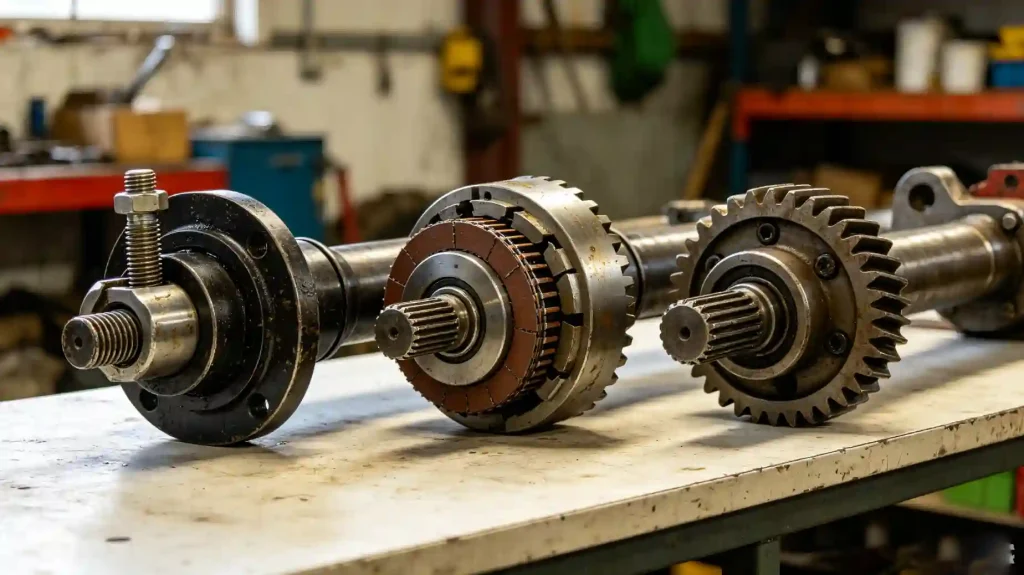
A PTO drive shaft is not a single piece of metal. It is an assembly of components, each serving a specific mechanical function:
- Outer and inner telescoping tubes: The two main tube sections that slide inside each other to accommodate changes in the working distance between tractor and implement. When a tractor makes a headland turn, the distance between the PTO stub and the implement input changes — the telescoping tubes absorb this length change without transmitting it as stress to the yokes or U-joints. The tubes must maintain a minimum overlap of one-third of their length at maximum extension to prevent tube separation.
- Universal joints (U-joints): Located at each end of the shaft, U-joints allow the shaft to operate at an angle relative to the tractor PTO axis and the implement input axis. This angular accommodation is essential because the implement is never in perfect alignment with the tractor PTO under field conditions. Standard U-joint PTO shafts operate correctly at working angles up to approximately 15 degrees. Beyond that, constant velocity (CV) joint shafts are required — common on wide discbine models from New Holland and Krone.
- Yokes: The forged steel forks at each end of the shaft that accept the U-joint cross kit and provide the splined or keyed connection to the tractor stub or implement input. Yokes are the highest-stress connection points in the assembly and must be forged to the correct strength class for the shaft series rating.
- Overload protection device: A shear bolt, friction disc slip clutch, ratchet clutch, or torque limiter positioned at one or both yokes. This device protects the tractor PTO gearbox and the implement input gearbox from damage when torque exceeds safe operating limits — for example, when a baler pickup blockage occurs or when a discbine strikes a buried rock.
- Plastic or metal guard assembly: The outer protective cover that surrounds the rotating shaft assembly. This is a legally required safety component in Canada and the United States. The guard is designed to rotate freely around the shaft rather than with it, so that contact with the guard by a person or object does not result in entanglement. A cracked, broken, or missing guard must be replaced immediately.
PTO Shaft Series Ratings: Matching Torque Capacity to Your Implement
PTO drive shafts are classified into series numbers — most commonly Series 4, Series 6, and Series 8 in North American agricultural use. Each series has a rated maximum torque capacity that must meet or exceed the torque demand of the implement it drives. Using a lower-series shaft than the implement requires is the most common cause of premature PTO shaft failure in North American farm operations.
- Series 4: Rated to approximately 1,500 Nm peak torque. Appropriate for conventional small square balers running at 540 RPM on tractors in the 40 to 80 HP range, smaller flail mowers, and compact horizontal feed mixers. The John Deere 336 and New Holland BC5050 are representative Series 4 applications.
- Series 6: Rated to approximately 3,000 Nm peak torque. The most widely used series in Canadian commercial hay and livestock operations. Covers most round balers (John Deere 459 through 569, New Holland Roll-Belt 450 through 560, Case IH RB344 through RB574), mid-size square balers, discbines operating at 1000 RPM, and mid-capacity vertical TMR feed mixers.
- Series 8: Rated to approximately 5,000 Nm peak torque. Required for large commercial square balers (New Holland BigBaler 330/340, Krone BigPack 1290 HDP XC, Case IH LB 434/444), heavy-duty commercial flail shredders, and large-capacity vertical TMR feed mixers on 150-plus HP tractors. This is the series that protects a high-value implement investment when peak torque demands are highest.
When the application falls on the boundary between two series, always select the higher series. The incremental cost difference between a Series 6 and Series 8 shaft is modest compared to the cost of a shaft failure mid-harvest on a large square baler or a commercial feed mixer. Metalite offers OEM-equivalent aftermarket shafts across all three series for the full range of North American market agricultural implements, with model-specific fitment available through the agricultural PTO drive shaft category.
PTO Shaft Applications Across Common North American Agricultural Implements
Every PTO-driven implement has unique speed, torque, and protection requirements. Here is a practical breakdown of how PTO shaft requirements differ across the implements most common in Canadian hay and livestock operations:
Square Balers
Square balers generate cyclical peak torque spikes with every plunger compression stroke. The heavy flywheel on most square baler designs stores kinetic energy between strokes, but the PTO shaft must still accommodate the angular acceleration and deceleration that occurs as the flywheel charges and discharges. Conventional small square balers (John Deere 336, 348; New Holland BC series; Case IH 8530) operate at 540 RPM with Series 4 shafts and shear bolt overload protection. Large commercial square balers (New Holland BigBaler, Krone BigPack, Case IH LB series) operate at 1000 RPM and require Series 6 or Series 8 shafts with slip clutch protection for practical day-to-day operation. Browse Metalite PTO shafts for square balers to find fitment options organized by brand and model.
Round Balers
Round balers apply a more sustained, continuous torque load rather than the cyclical spikes of a square baler. The PTO shaft must sustain this load reliably across thousands of bales per season. Modern round balers from John Deere (459 through 569 series), New Holland (Roll-Belt 450 through 560), Case IH (RB344 through RB574), and Krone (Comprima and Fortima series) all operate at 540 or 1000 RPM depending on the tractor horsepower class, with Series 4 or Series 6 shafts and slip clutch protection as the standard specification.
Discbines and Disc Mowers
Discbines operate at 1000 RPM with high-inertia disc cutter bars that store significant rotational energy. A rock strike transfers that energy back through the shaft as a near-instantaneous torque spike. Slip clutch protection is non-negotiable on discbine applications. Wide discbine models from New Holland (400-series) and Krone (EC 3200) require CV joint shafts to accommodate the working angles created by the wide cutter bar offset. Telescoping length is also critical on discbines, as the cutter bar articulates over ground contours and changes the effective shaft working length continuously.
Feed Mixers (TMR Wagons)
Vertical TMR feed mixers are among the highest sustained-torque PTO-driven implements in any livestock operation. Running at 1000 RPM and processing dense silage, hay, and grain concentrate loads, commercial mixers from Jaylor, Peecon, Knight, and Roto-Mix require Series 6 or Series 8 shafts with friction disc slip clutch protection. The slip clutch is essential here because the overload conditions caused by dense material entering the auger occur repeatedly throughout every mixing cycle — a shear bolt configuration is operationally impractical at commercial feed-mixer throughput.
Flail Shredders and Flail Mowers
Flail shredders operate at either 540 or 1000 RPM depending on rotor design and working width. The flail rotor creates repetitive impact loads as it contacts vegetation, branches, and field debris. Light-duty flail mowers (60 to 84 inch working width) running at 540 RPM typically use Series 4 shafts with ratchet or friction slip clutch protection. Heavy-duty commercial flail shredders (84 inch and wider, 100-plus HP) operating at 1000 RPM require Series 6 or Series 8 shafts with multi-disc friction clutch protection.
Common Tractor PTO Problems and What They Mean
Recognizing early warning signs of PTO system problems prevents small issues from becoming costly failures. The following are the most frequently reported PTO problems on North American farm operations:
- PTO shaft vibration at field speed: Usually indicates a worn or seized U-joint cross kit, an incorrect working angle exceeding 15 degrees, or telescoping tubes near their minimum overlap at the operating position. Inspect U-joints for binding. Measure the working angle and reposition the implement hitch if necessary.
- PTO shaft stuck on tractor (will not disengage from stub shaft): Most commonly caused by corrosion seizing the spline connection, a bent quick-release collar, or a worn yoke quick-release groove. Apply penetrating oil and allow time to work. Do not strike the yoke with a hammer. If corrosion is severe, a shaft replacement is often more practical than attempting to free a heavily corroded connection.
- Slip clutch slipping at normal working torque: Indicates worn or glazed friction disc surfaces, or a spring pre-load that has dropped below the correct disengagement torque setting. Inspect friction surfaces and re-tension the clutch spring. If discs are glazed, replace them before continuing operation — a clutch that slips at working load wastes power and generates heat that accelerates further wear.
- Shear bolts failing repeatedly in the same field conditions: If a shear bolt breaks more than once or twice per day in conditions the baler is rated for, verify that the bolt grade and diameter match the OEM specification exactly. Hardware store substitutes are frequently the wrong grade and fail at incorrect torque values. Consider upgrading to a slip clutch PTO shaft for the application.
- PTO shaft clunking sound during turns or transport: Indicates the shaft is either compressing to solid length during close-range operation, or the U-joint crosses have developed excessive play from wear. Measure the shaft compressed length and compare against the specification. Replace U-joint cross kits at the first sign of rough rotation or looseness in the joint.
PTO Safety: What Every Canadian Farm Operator Must Know
PTO-related accidents are among the most severe in agricultural safety statistics. The rotating shaft, operating at 540 or 1000 RPM, can entangle clothing, hair, or limbs in a fraction of a second if the guard is absent or damaged. The following non-negotiable safety practices apply to every PTO operation:
- Always verify the guard is present, intact, and rotating freely before engaging the PTO. A guard seized to the shaft rotates with it and provides no entanglement protection.
- Disengage the PTO and wait for complete rotation stop before dismounting the tractor for any reason, including unclogging a pickup, adjusting the implement, or checking a connection.
- Never step over or reach across a rotating PTO shaft. Always walk around the equipment.
- Ensure the safety chain on the guard is attached at both ends. The chain prevents the guard from rotating with the shaft if the outer bearing of the guard seizes.
- Wear close-fitting clothing with no loose ends, drawstrings, or untucked layers when operating PTO-driven equipment. Loose clothing is the most common entanglement factor in PTO accidents.
- Replace damaged or missing guards immediately. In Canada, farm operators have a legal duty of care under provincial occupational health and safety legislation to maintain safety guards on powered equipment.
Frequently Asked Questions About Tractor PTO Shafts
Need a PTO Shaft for Your Tractor or Implement? Metalite Has You Covered
Metalite is a Canadian agricultural PTO drive shaft supplier providing OEM-equivalent aftermarket replacements for the full range of North American hay and livestock equipment. Whether you need a single replacement shaft to get back in the field or a pre-season fleet order for a commercial operation, our team can confirm fitment and get your order moving.
- ✓ Series 4, 6, and 8 shafts for 540 RPM and 1000 RPM applications
- ✓ Shear bolt, slip clutch, ratchet, and CV joint configurations
- ✓ Fitment for John Deere, New Holland, Case IH, Krone, AGCO, Jaylor, Peecon, and more
- ✓ Bulk and OEM custom specification orders available
- ✓ Shipping to all Canadian provinces
Contact the Metalite technical sales team: [email protected]
Responses within one business day. Have your tractor and implement make, model, and shaft measurements ready for the fastest fitment confirmation.
editor:WM