
Industries that push machinery into unusual environments, unconventional output speeds, or demanding chemical and mechanical conditions generate the most frequent requests for non-standard worm gearboxes. Solar tracking systems need corrosion-resistant units at ratios that no standard catalog covers. Plastic extruders need high-torque worm gearboxes with output shaft configurations built around proprietary screw interfaces. Marine equipment needs full-salt-spray protection on gearboxes that will never be easily serviced once installed. Each of these industries has a recognisable set of requirements that drives beyond what catalog units provide.
This guide covers the application scenarios most commonly served by EPG Canada’s Non-Standard Worm Gearbox program — the technical drivers behind each requirement and how the custom specification addresses them. For information on what parameters define a non-standard gearbox and how to structure an enquiry, see the Non-Standard Worm Gearbox Specification and Sourcing Guide.
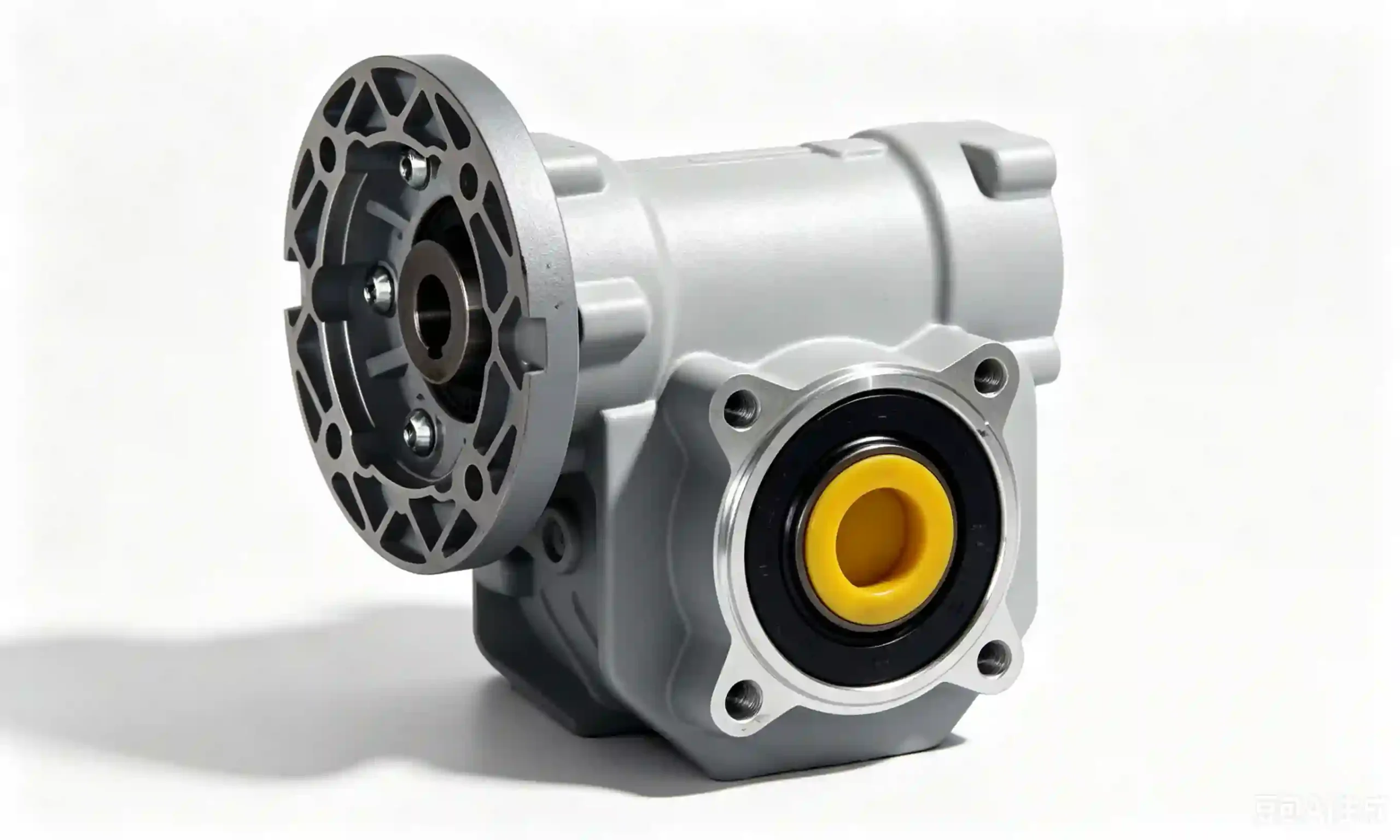
Custom worm gearboxes for solar tracking, marine equipment, extruders, and OEM machinery where catalog units don’t fit
Solar Panel Tracking Systems
Solar single-axis and dual-axis tracking systems are an almost textbook case for non-standard worm gearbox requirements. The drive must operate outdoors continuously for 20–25 years with virtually no maintenance access — not because service is inconvenient, but because service contracts for large utility-scale solar fields are written to minimise field interventions to perhaps once per year. The gearbox must simply be reliable and sealed for the full service period.
The ratio requirement is typically in the range of 400:1 to 1,000:1 — enough to drive the tracker from solar noon to west horizon in 6 hours using a small fractional-horsepower motor. This ratio falls outside the standard single-stage range (5:1 to 100:1) and is only achievable in a two-stage arrangement. Standard two-stage catalog combinations are available, but the mounting geometry, torque arm configuration, and slip-ring or cable interface for panel wiring typically require housing modifications that push the specification into non-standard territory.
Technical Requirements — Solar Tracking
- Ratio: 400:1 to 1,000:1 (two-stage)
- Housing: Hot-dip galvanized or stainless steel 304 for 25-year UV and salt-mist exposure
- Sealing: IP65 minimum; IP67 preferred for regions with seasonal flooding
- Lubricant: Long-life synthetic PAG grease (no oil drain possible in field)
- Output: Hollow bore for direct torque tube or shaft mounting; torque arm provision
Why Non-Standard Is Required
- Combined ratios of 400:1–1,000:1 require custom two-stage gear pair not in standard catalog
- Hot-dip galvanized housing not offered in standard product range
- Torque tube bore sizes vary by tracker system manufacturer — hollow bore must match specific tracker hardware
- Backlash must be specified to meet tracker angular accuracy requirements (typically ±0.1° to ±0.5°)
Plastic, Rubber, and Food Extruder Drives
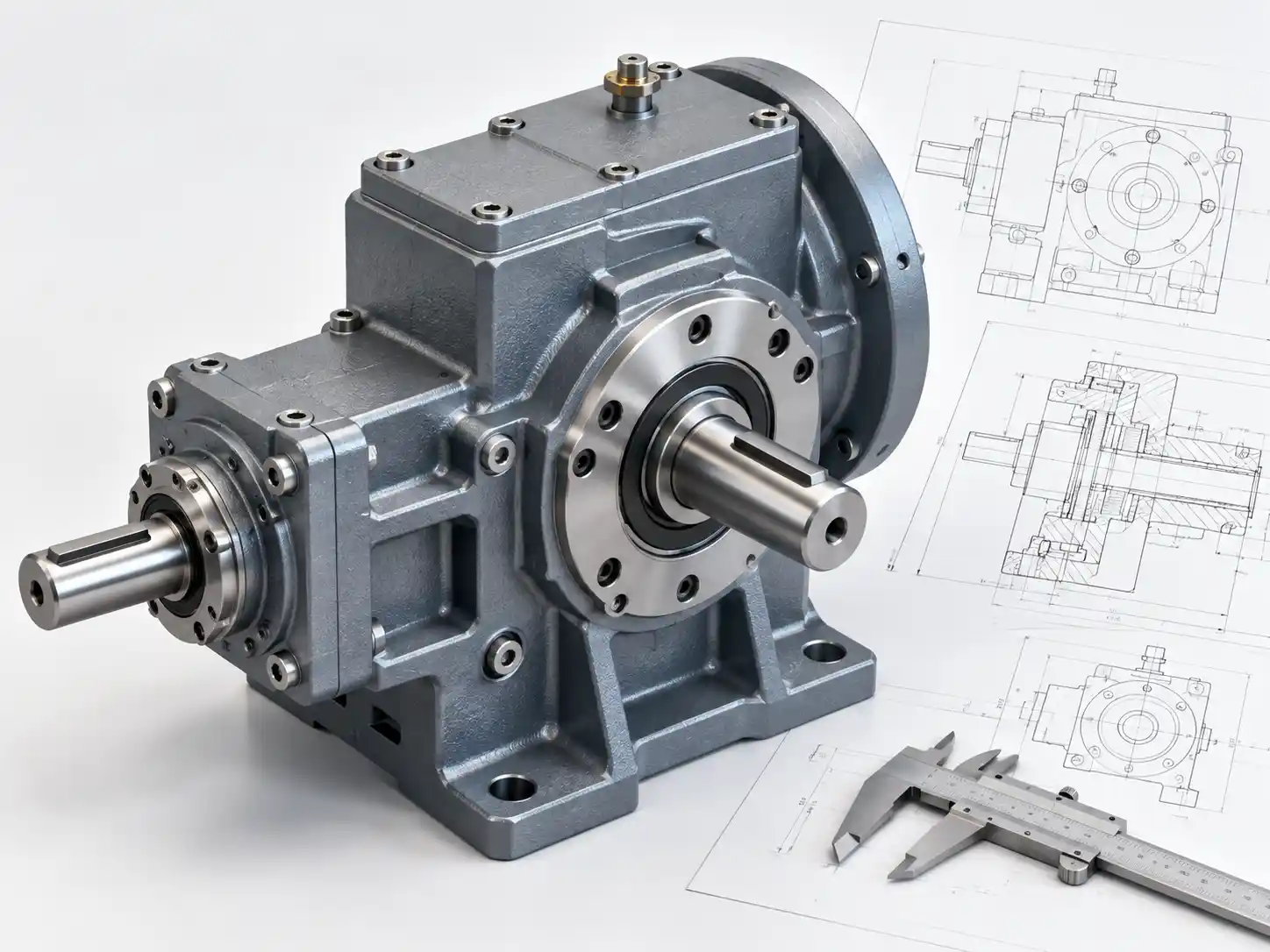
Extruder drives are high-torque, low-speed applications that impose several non-standard requirements simultaneously. The output shaft must interface with the extruder screw’s proprietary coupling — which varies by extruder manufacturer, screw diameter, and shaft key geometry. The torque levels on large extruder drives (above 100 mm screw diameter) often exceed the WP250 catalog maximum, requiring a custom gear pair at a larger center distance. And the thermal environment at the extruder barrel — with radiant heat from the barrel heaters and the mechanical heat of viscous polymer processing — demands careful attention to the gearbox’s thermal rating.
Food extruder drives add a further requirement: the gearbox must be specified with food-grade lubricant, hygienic surface treatment, and — if positioned above the product stream — stainless steel housing to prevent corrosion contamination. These requirements push a food extruder drive firmly into non-standard territory regardless of whether the torque and ratio requirements could be met by a catalog unit.
Common Extruder Gearbox Non-Standard Requirements
Inch keyway on output shaft
Above-catalog torque (custom gear pair)
Stainless steel housing (food extruders)
NSF H1 food-grade lubricant
Thermal guard for barrel heat
Multi-start worm (higher efficiency for 24/7 run)
Marine and Offshore Equipment
Marine and offshore installations subject gearboxes to salt spray, high humidity, vibration from vessel motion or wave action, and restricted maintenance access once the equipment is at sea or on an offshore platform. These conditions collectively require a level of corrosion protection and seal integrity that the standard painted cast iron housing simply does not provide reliably over a multi-year service period without maintenance intervention.
Marine non-standard worm gearboxes typically specify stainless steel 316L housing (providing full marine-grade corrosion resistance without surface coating maintenance), IP67 or IP68 sealing for wave wash-over or temporary submersion, and a lubricant grade rated for the expected temperature range — from below 0°C in northern climates to 45°C in tropical installations. Shaft seals are upgraded to PTFE-lipped Viton on all marine specifications.
- Deck winch and windlass drives: Custom high-torque WP-equivalent gearboxes in stainless steel housing, with high-ratio worm pair for slow controlled haul-in and the self-locking property required to hold the load when the winch motor is de-energised.
- Hatch and watertight door actuators: Low-ratio worm gearboxes (5:1 to 20:1) with fast-close capability — non-standard ratio and flanged output to match the hatch or door actuating mechanism.
- Stabilizer fin drives: High-performance worm gearboxes with low backlash and stainless steel housing — the fin position determines vessel stability, so positioning accuracy and corrosion resistance are both mandatory.
- Offshore platform auxiliary drives: Non-standard ratio, stainless or galvanised housing, ATEX-rated for Zone 1 explosive gas atmosphere where hydrocarbon vapour is present.
Agricultural and Irrigation Machinery
Agricultural machinery operates in conditions that combine the demands of outdoor installation, high dust and soil contamination, wide seasonal temperature swings, and very long service intervals — machinery parked in a field shed for 8 months before being returned to service for the planting or harvesting season. Gearboxes in this environment must be robust enough to survive storage without inspection, and reliable enough to operate without failure during the compressed window when the machine is actually needed.
Non-standard requirements in agricultural applications typically arise from PTO (power take-off) input interfaces — standard shaft diameters of 1⅜” or 1¾” inch for tractor-driven equipment, which require non-metric input shaft configurations that no standard catalog unit carries. Center-pivot irrigation drives also require custom hollow bore sizes to match the pivot tube diameter and non-standard output ratios determined by the irrigation circle radius and required rotation speed.
Centre-pivot irrigation
Non-standard hollow bore to match pivot tube O.D.; hot-dip galvanized housing; long-interval grease fill; ratio determined by circle radius and motor speed.
PTO-driven equipment
Inch PTO input shaft (1⅜” 6-spline or 1¾” 20-spline) requires non-standard input configuration not available in the standard catalog motor-input format.
Greenhouse automation
Vent and screen drive gearboxes at low torque but high-IP sealing — typically stainless or anodized aluminum in humid, high-chemical (pesticide) environments.
Silo and conveyor drives
High-ratio worm gearboxes on chain conveyor and auger drives — often requiring non-standard output shaft lengths or integrated sprocket hubs.
Defense and Aerospace Ground Support
Defense and aerospace ground-support equipment — missile handling carts, aircraft maintenance platforms, radar antenna drives, weapons loading equipment — places unusual demands on gearbox design that go beyond mechanical performance: material traceability, qualification testing, documentation packages compliant with military standards (MIL-SPEC or equivalent), and lifetime warranty on critical components.
Non-standard worm gearboxes in this sector are typically specified to customer drawings with approved material grades and full inspection documentation. The worm gearbox format is preferred for many ground-support drives because of its compact right-angle geometry, high single-stage ratio capability, and self-locking property — important on any mechanism that must hold a load in position under gravity without continuous motor power.
Documentation capabilities: EPG Canada can provide first-article inspection reports (FAIR), material test certificates to EN 10204 3.1 standard, dimensional inspection reports, functional test data (torque efficiency, backlash measurement), and PPAP documentation for high-volume defense OEM supply. Confirm your documentation requirement at the enquiry stage — documentation packages add lead time and cost that must be planned for.
OEM Retrofit and Legacy Gearbox Replacement
One of the most practical applications of non-standard worm gearbox manufacturing is the replacement of obsolete or discontinued gearboxes in production equipment still generating value. When a machine’s original gearbox supplier has discontinued the model, the options are: rebuild the original (expensive, slow, and often involves sourcing obsolete parts), replace with a standard catalog unit and modify the machine (disrupts production, high engineering cost), or commission a dimensionally compatible replacement from EPG Canada.
Providing a sample gearbox, a nameplate photo, or key dimensional measurements (center distance, shaft diameters, housing bolt pattern, output torque if known) is sufficient to initiate a retrofit design. Where the original gearbox had known failure modes — a weak output shaft, insufficient sealing for the environment, or a bronze alloy prone to rapid wear — EPG Canada will incorporate improvements in the replacement specification.
Information We Need for a Retrofit
- Physical sample or dimensional drawing of the existing unit
- Nameplate photo (model number, ratio, serial number)
- Output torque or motor power (if known)
- Input and output shaft diameters, keyway dimensions
- Housing bolt pattern and mounting hole positions
What EPG Canada Delivers
- Dimensionally compatible replacement — drop-in fit without machine modification
- Improved specification where original had known weaknesses
- Dimensional inspection report confirming key interface dimensions
- Stocked replacement for ongoing maintenance once initial batch is approved
- Response to initial enquiry within 48 hours
How EPG Canada Handles Custom Worm Gearbox Projects
Enquiry & Feasibility
Within 48 hours of receiving your specification, our engineering team confirms feasibility and flags any design concerns or alternative approaches.
Technical Proposal
A preliminary technical specification and indicative pricing is issued — including confirmed ratio, torque rating, housing specification, lead time, and MOQ discussion.
Drawing Approval
Customer-approved 2D dimensional drawing is issued before production begins. One round of drawing revision is included at no charge.
Production & QC
Manufacturing, assembly, functional test (efficiency, backlash, oil seal integrity), and QC documentation. First articles are offered on all new non-standard specifications.
Ongoing Supply
Once approved, the specification is retained and can be reordered with shorter lead times — the drawing, material spec, and gear pair tooling are held for future runs.
Discuss Your Custom Worm Gearbox Requirement
Whether you are replacing an obsolete unit, specifying a tracker drive, or engineering a machine with a unique output interface — EPG Canada responds within 48 hours with a feasibility assessment and indicative pricing.
Include a description of the application, input/output speeds and torque, any dimensional constraints, and a sketch or photo if available.
Frequently Asked Questions
Related Pages