
Servo motors are only half of a precision drive system. The gearbox between the motor and the load determines whether the servo’s positioning capability is actually delivered to the output shaft — or lost in mechanical play, torsional compliance, and misalignment. The right angle servo worm gearbox has become the standard interface between servo motors and precision positioning loads across a broad range of industries: CNC machining, industrial robotics, automation, semiconductor handling, and medical equipment.
This guide covers the application scenarios where the low backlash right angle servo worm gearbox is the correct and preferred drive choice — and the specific technical requirements each application places on the gearbox. For full specifications, backlash grades, and frame size selection, see the Low Backlash Right Angle Servo Worm Gearbox Specifications page.
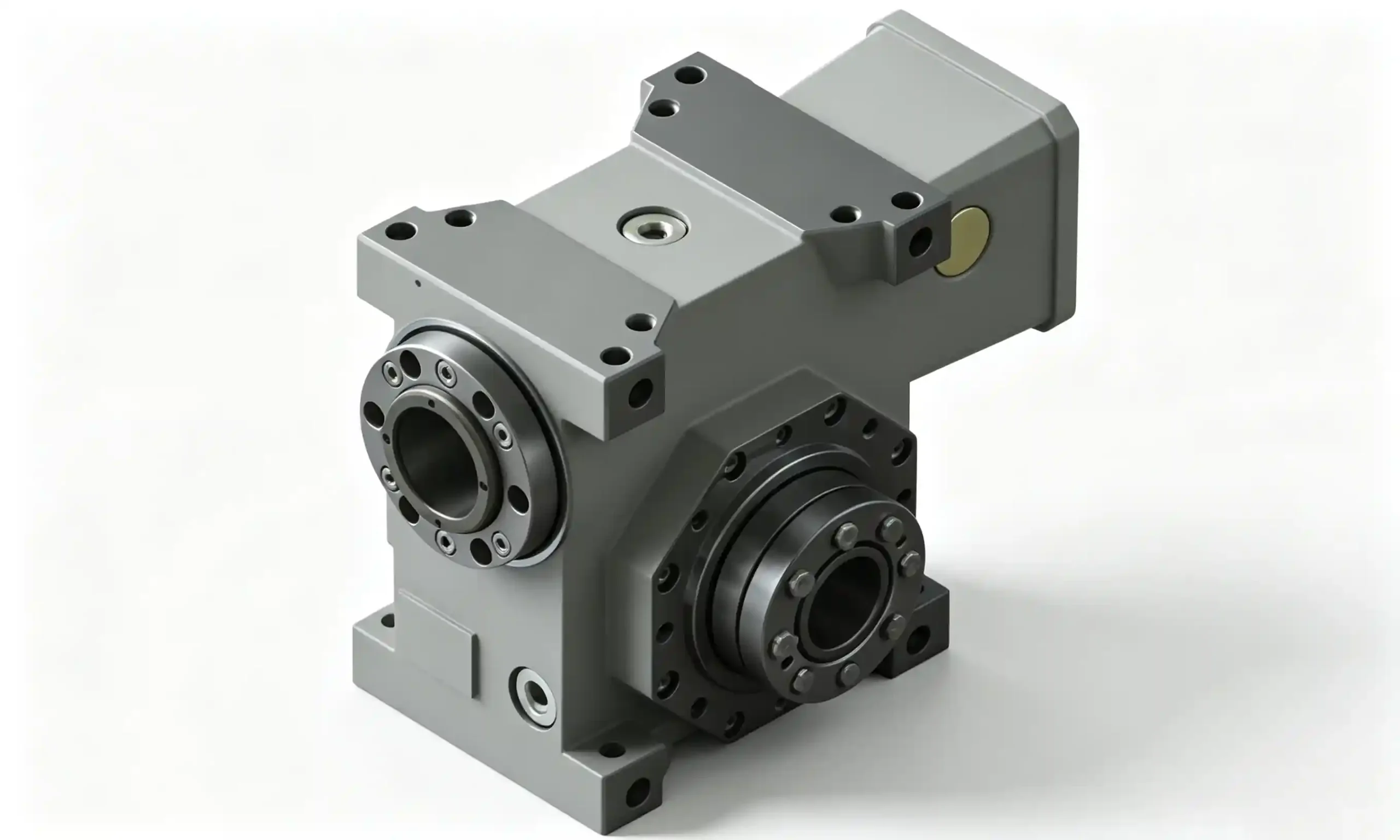
Servo worm gearboxes in precision automation — from CNC rotary tables to robot joints and medical positioning systems
Why Right Angle? The Space and Ratio Advantage in Precision Automation
Precision automation machines are dense with components. Motors and gearboxes compete for space with linear rails, ball screws, rotary encoders, brakes, coolant plumbing, and cable trays. The right-angle geometry of the worm gearbox places the motor axis perpendicular to the output axis — allowing the motor to be located where space allows, rather than inline with the drive shaft where it would extend the machine envelope.
90:1 in a Single Stage
A single-stage servo worm gearbox achieves up to 90:1 in the same axial length a planetary gearbox needs two stages to reach 25:1. For high-ratio precision positioning applications — slow rotary tables, telescopic positioning stages — this compact high-ratio capability is the deciding factor for the worm format.
Cost vs Planetary at Same Torque
Precision planetary gearboxes at equivalent backlash grade and torque rating are typically 2–3× the cost of a precision servo worm gearbox. For applications where the right-angle geometry is not a disadvantage and ratios above 20:1 are required, the servo worm gearbox offers significant cost efficiency without sacrificing positioning performance.
Low Noise Below 55 dB
The sliding worm-to-wheel contact — the same property that limits efficiency at high ratios — produces quieter operation than helical planetary gears in many automation environments. Medical equipment, laboratory automation, and semiconductor handling all benefit from the noise profile of the worm drive at moderate speeds.
CNC Rotary Tables and 4th / 5th Axis Machining
The CNC rotary table is the original and most demanding application for the precision servo worm gearbox. A 4th-axis rotary table holds the workpiece at a commanded angle while the spindle machines it — and the holding position must remain accurate under the cutting force applied by the tool. A 5th-axis trunnion or tilting-table drive changes the workpiece inclination angle during a machining pass, with the required accuracy of the angular motion determining the achievable part tolerance.
The servo worm gearbox satisfies this application’s three simultaneous requirements: low backlash for accurate positioning before the cut, high torsional stiffness to resist deflection under cutting force without position error, and self-locking capability (at ratios above 30:1) that holds the table angle without continuous motor power during a long machining pass.
Typical CNC Rotary Table Gearbox Selection Parameters
Backlash Grade
Precision (<5′) for general turning centres; Expert (<1′) for grinding and gear machining
Ratio Range
40:1 to 90:1 — slower table speed permits higher positioning accuracy during the machining pass
Output Configuration
Rotary output flange — directly bolts to the table underside, minimising dead stack height
Frame Size
S4–S6 for tables up to 500 mm diameter; S7–S8 for heavy 5-axis pallet tables
Industrial Robotics and Articulated Arms
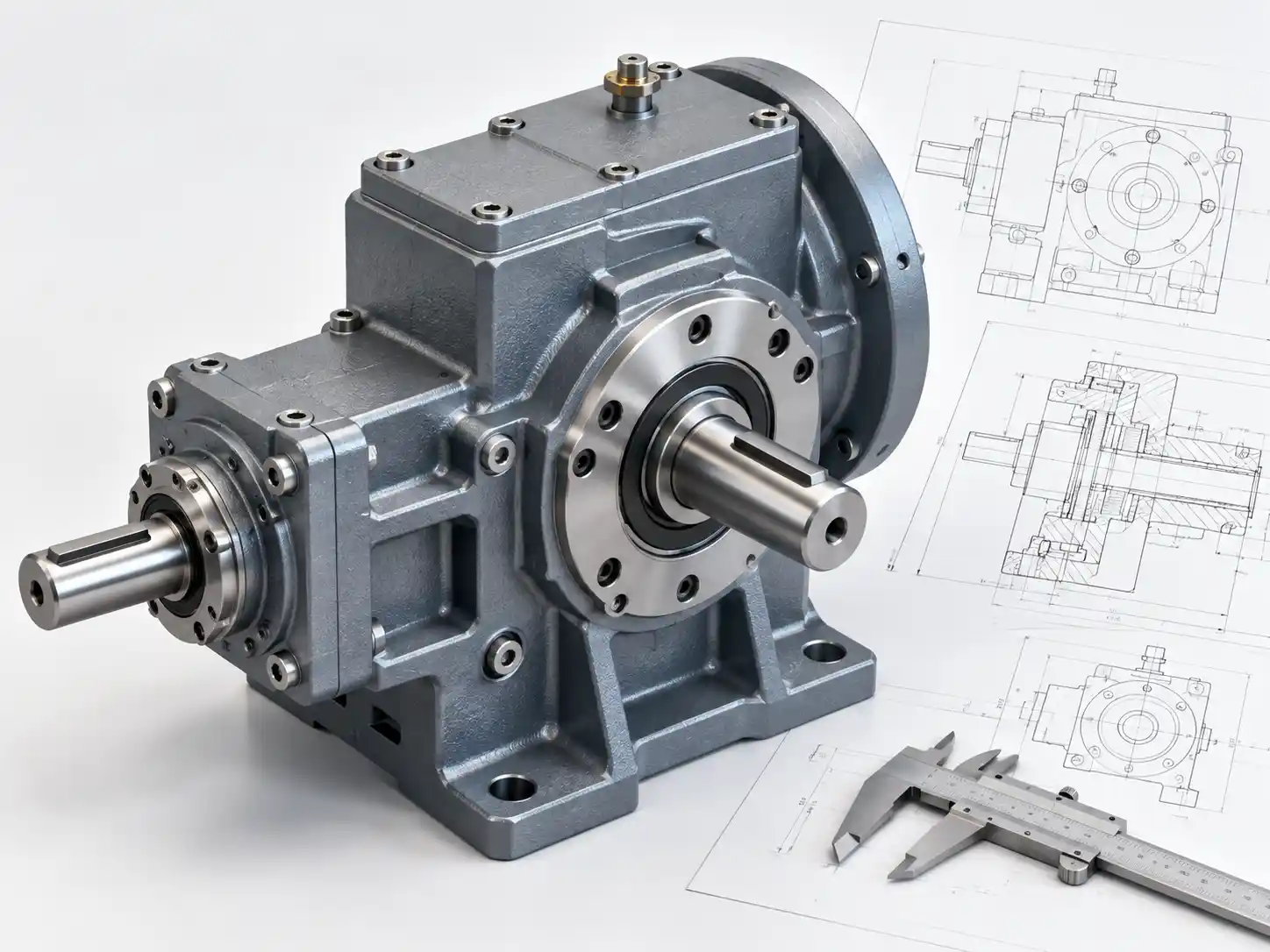
Robot joints in articulated arm robots, SCARA robots, and delta pick-and-place robots require a gearbox that can change direction hundreds of thousands of times during the robot’s service life without accumulating positioning error. The consistent backlash property of the precision servo worm gearbox — maintained by the three-bearing preload design across the service life — makes it a reliable choice for robotic joint drives where periodic recalibration for backlash growth is not acceptable.
The right-angle output geometry is particularly useful in articulated arm designs where the motor axis and joint rotation axis are perpendicular by the arm’s mechanical layout — a worm drive satisfies this geometry directly without an additional bevel gear stage. The compact aluminum housing also fits the mass and volume constraints that robot arm design imposes, where every kilogram of gearbox mass at the end of an arm increases the required base motor torque by a factor of the arm reach.
SCARA robot shoulder and elbow
Ratios of 20:1 to 50:1 — high repeatability in a compact, lightweight unit is the primary requirement.
Articulated arm wrist joint
High-ratio (60:1 to 90:1) in a small frame size — the worm gearbox’s single-stage high ratio is a decisive advantage over planetary in confined wrist envelopes.
Cartesian gantry axes
Rotary-to-linear conversion via rack and pinion or ball screw — the worm gearbox provides right-angle motor placement that simplifies cable routing along the gantry beam.
Collaborative robot (cobot) joints
The worm drive’s inherent self-locking at higher ratios contributes to passive safety in collaborative robot designs where backdriving the motor under collision loads must be limited.
Packaging Pick-and-Place and Servo Folding Drives
Packaging machinery has undergone a fundamental shift in the last decade — from mechanically cammed, single-speed machines to servo-driven flexible platforms that change format by reprogramming rather than by replacing mechanical cams. This shift places new demands on the gearbox: it must handle high cycle rates (up to 60–150 positioning events per minute on some pick-and-place heads), frequent full reversals, and the dynamic load variations inherent in accelerating and decelerating the tooling head and gripper mass.
The precision servo worm gearbox satisfies all three of these requirements in a compact package that fits within the tight machine frame envelopes typical of European-style packaging machinery. The Basic or Precision backlash grade is sufficient for most packaging servo applications — the exact angular repeatability required for box flap folding, carton erecting, and bottle orientation is typically in the 5–15 arc-minute range, well within the Precision grade’s <5 arc-minute specification.
- Carton erectors: Servo drives at each folding station replace mechanical cam systems — S3 or S4 frame at 20:1 to 40:1, Precision grade.
- Case packers: Servo-driven loading heads that rotate to place products — S4 or S5 frame at 30:1 to 60:1, Precision grade.
- Vertical form-fill-seal film drives: Servo pull-down belt drives with precise film step control — right angle output allows motor to be placed above the machine frame.
- Rotary filling stations: Servo-indexed turntable drives at high cycle rates — self-locking at ≥30:1 ratio holds the table position without motor power during the fill dwell time.
Semiconductor Handling and Laboratory Automation

Semiconductor wafer handling, lithography stage drives, laboratory sample positioning, and automated test equipment (ATE) represent the highest precision tier of servo worm gearbox applications. These are the environments where the Expert grade (<1 arc-minute) backlash specification is justified — and where the aluminum-magnesium housing’s clean-room compatibility and low noise output are as important as the backlash specification.
Wafer alignment systems require both precision angular positioning and absolute repeatability across thousands of cycles without drift. The consistency of the three-bearing preload system — which prevents thermal backlash drift — is a key design requirement for this class of application, since recalibration in a wafer handling robot requires a machine stop and clean-room re-entry, both of which are expensive in a high-throughput fab environment.
Wafer alignment stages
Expert grade (<1′) — S1 or S2 frame. Clean aluminium housing for Class 100 or better clean-room use.
Lab robotic sample handlers
Precision grade (<5′) — compact S2 or S3 frame. Low noise for quiet laboratory environments.
ATE probe stations
Expert grade — the theta (rotation) axis on wafer probe stations requires sub-arc-minute angular accuracy for probe-to-pad alignment at fine pitch.
Liquid handling robots
Precision grade — multi-axis liquid dispensing robots in pharmaceutical research and diagnostic labs, where quiet and smooth movement is required.
Medical Equipment and Surgical Positioning Systems

Medical equipment imposes a unique combination of requirements on drive components: precision positioning accuracy (for imaging alignment and surgical tool guidance), extremely quiet operation (patient comfort and acoustic environment requirements), clean non-rusting surfaces (infection control), and IEC 60601-series compliance for electrical integration with the servo drive system.
The servo worm gearbox’s aluminium housing, sub-55 dB noise output, and compact right-angle geometry make it the standard drive choice for a broad range of medical positioning applications. The self-locking property at higher ratios contributes to passive safety on patient support surfaces — the table holds position if the motor de-energises without the patient noticing or the position drifting.
- MRI and CT table drives: S5 or S6 frame, Precision grade — the table must advance and retract reproducibly to ±1 mm axial position for image reconstruction accuracy.
- C-arm positioning: S4 frame, Precision grade — the C-arm rotates around the patient in precise angular increments for multi-angle imaging without repositioning the patient.
- Surgical robot wrist axis: S2 or S3 frame, Expert grade — the tool-tip orientation in robotic surgery requires sub-arc-minute repeatability for consistent suture placement and tissue dissection.
- Radiation therapy couch drives: S6 or S7 frame, Precision grade — 6-degrees-of-freedom patient positioning tables require precise and reproducible angular and translational positioning for radiation field alignment.
Selecting the Right Backlash Grade: A Decision Framework
Over-specifying the backlash grade adds cost without adding positioning benefit. Use this framework to identify the correct grade for your application before requesting a quotation:
| Application Type | Required Repeatability | Recommended Backlash Grade | Typical Ratio |
|---|---|---|---|
| General servo indexing (non-critical) | ±0.5° or coarser | Basic (<10′) | 10:1 – 40:1 |
| CNC 4th axis, SCARA robot, packaging servo | ±0.05° – ±0.1° | Precision (<5′) | 20:1 – 60:1 |
| CNC 5th axis, articulated robot wrist | ±0.02° – ±0.05° | Precision (<5′) or Expert (<1′) | 40:1 – 90:1 |
| Grinding / gear machining, wafer alignment | ±0.01° or finer | Expert (<1′) | 60:1 – 90:1 |
| Surgical robot, medical imaging alignment | ±0.01° or as regulated | Expert (<1′) | 30:1 – 90:1 |
Important: The backlash grade is a necessary but not sufficient condition for positioning accuracy. Encoder resolution, servo tuning, mechanical compliance of the output coupling or table bearing, and thermal effects all contribute to the final positioning accuracy. Contact our technical team with your full drive chain specification for a positioning accuracy analysis before finalising the backlash grade.
Specify Your Servo Worm Gearbox
Tell us your application, servo motor brand and frame, required ratio and output torque, and target backlash grade. Our engineers will confirm the correct size, grade, and configuration within 24 hours.
Frequently Asked Questions
Related Pages